There is a particular kind of frustration that history lovers know well.
You read that Gutenberg invented the printing press. You understand that it changed everything. But you have never actually seen how it worked — the mechanism, the components, the physical ingenuity behind the most disruptive invention in human history.
Textbooks tell you what happened. They almost never show you how.
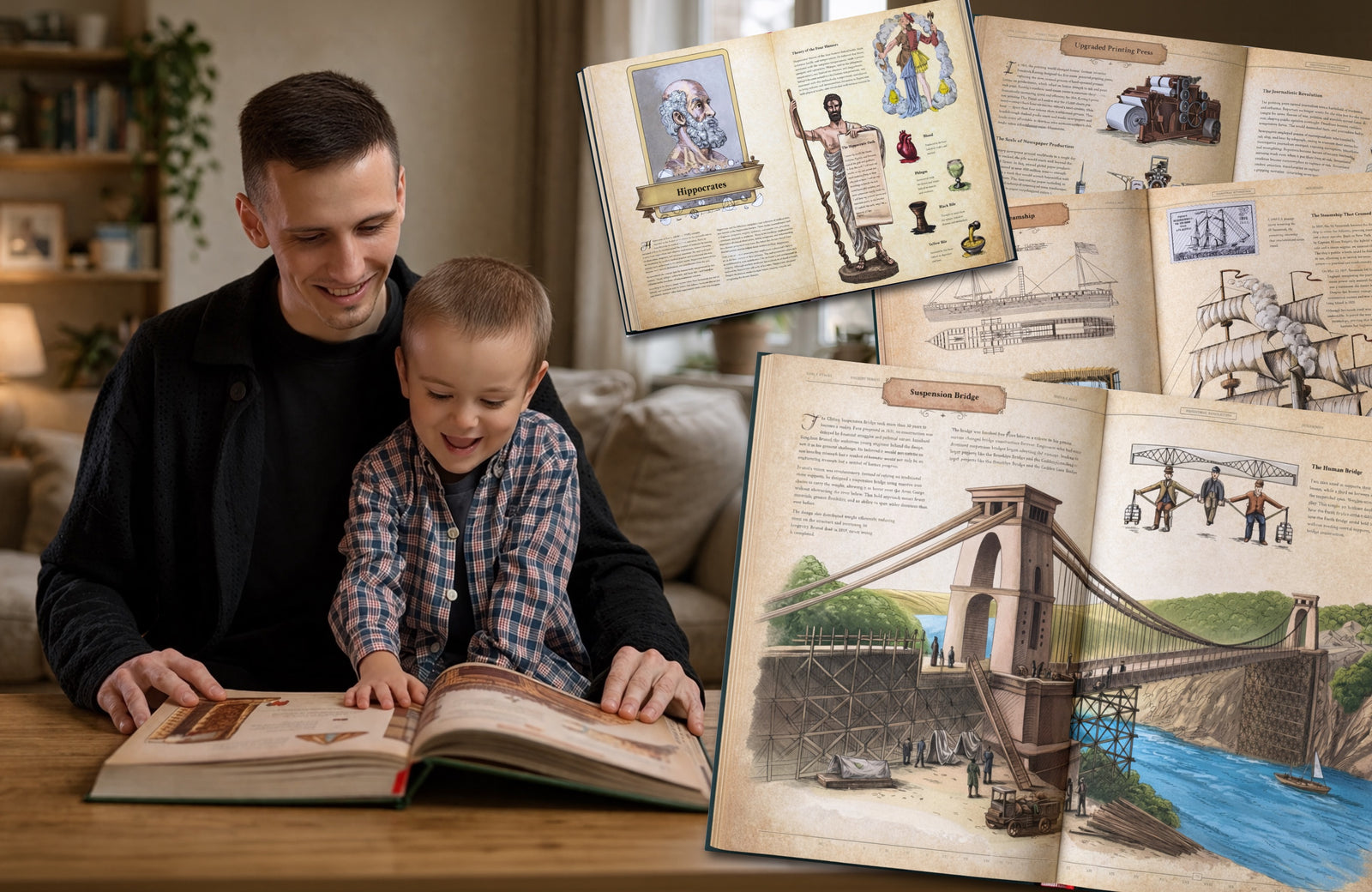
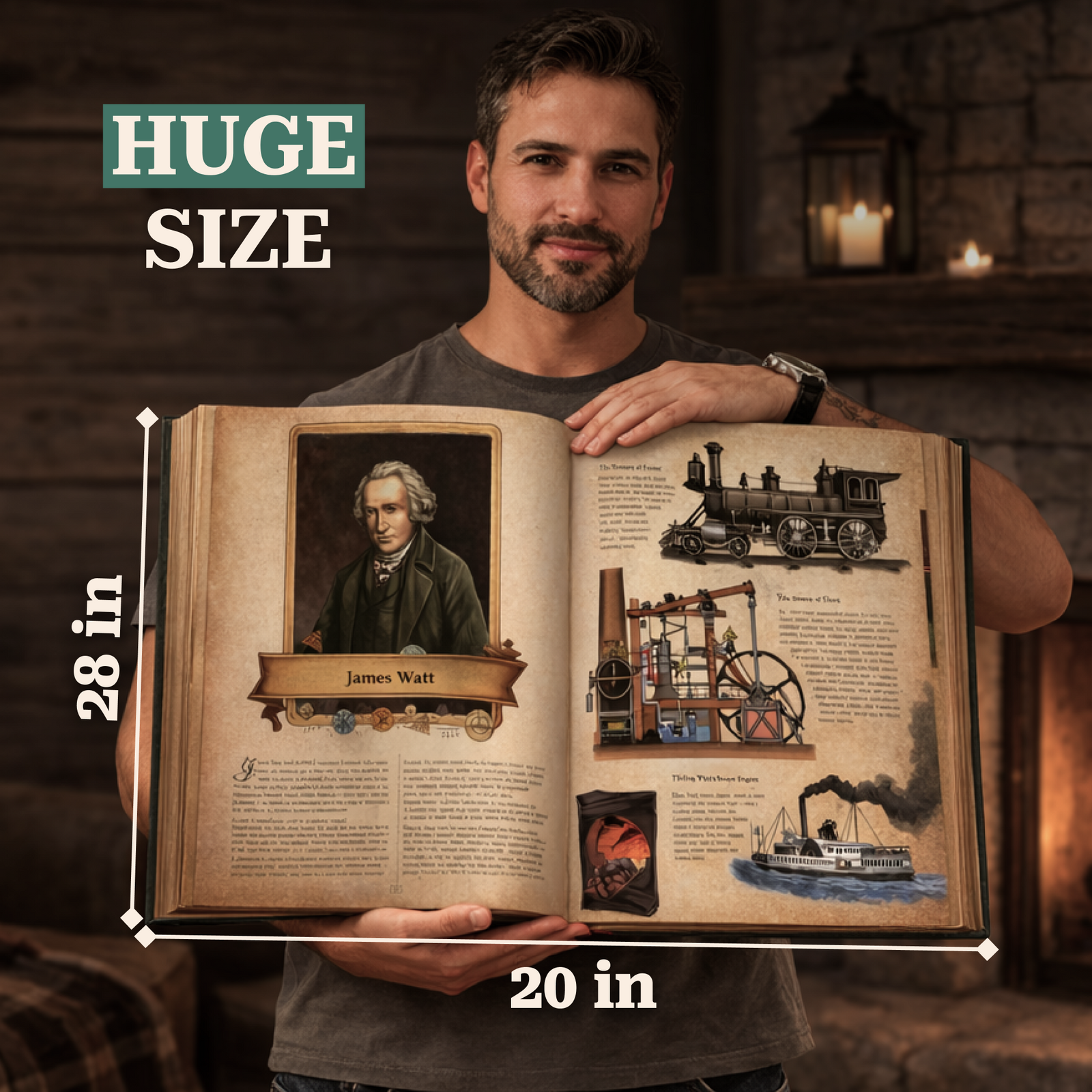
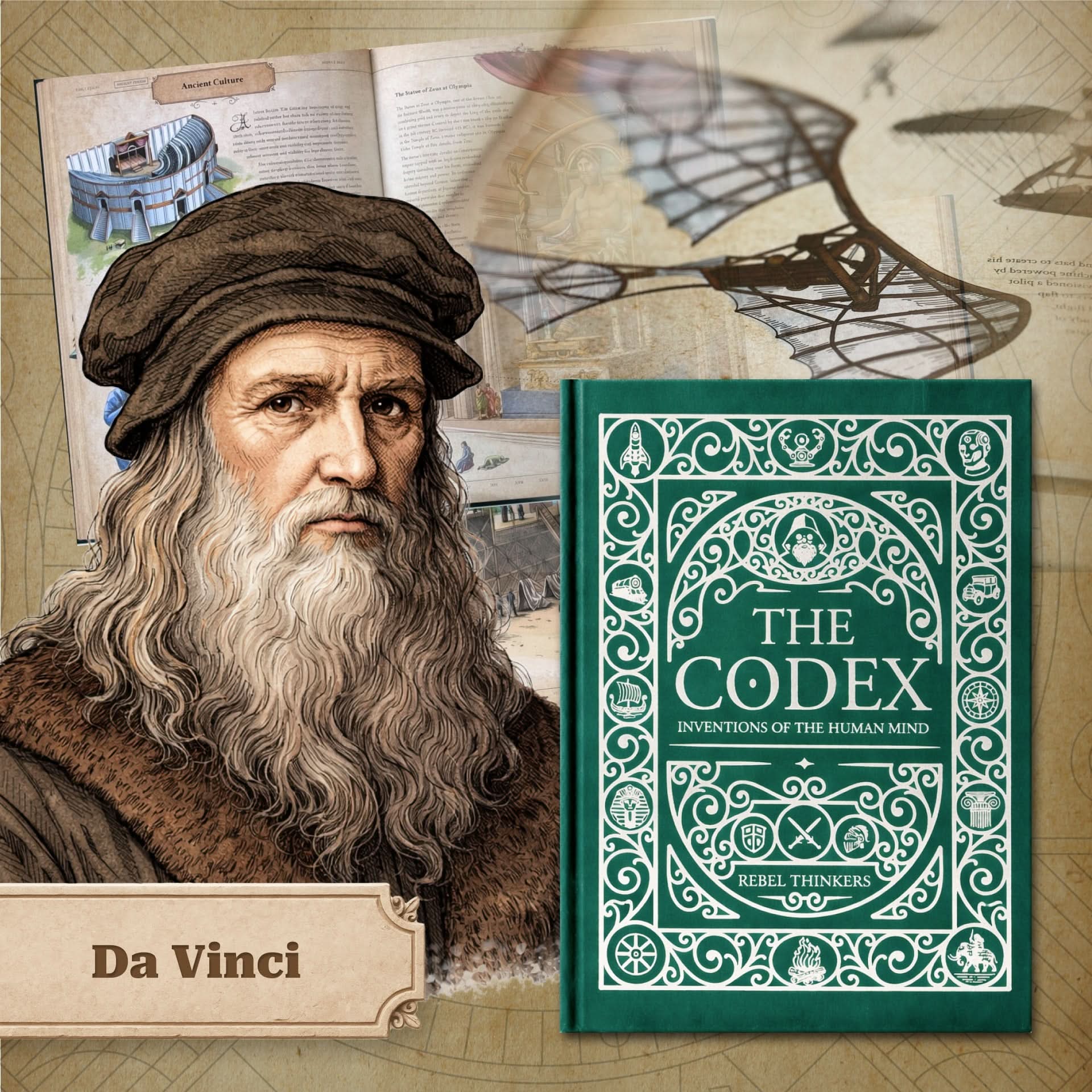
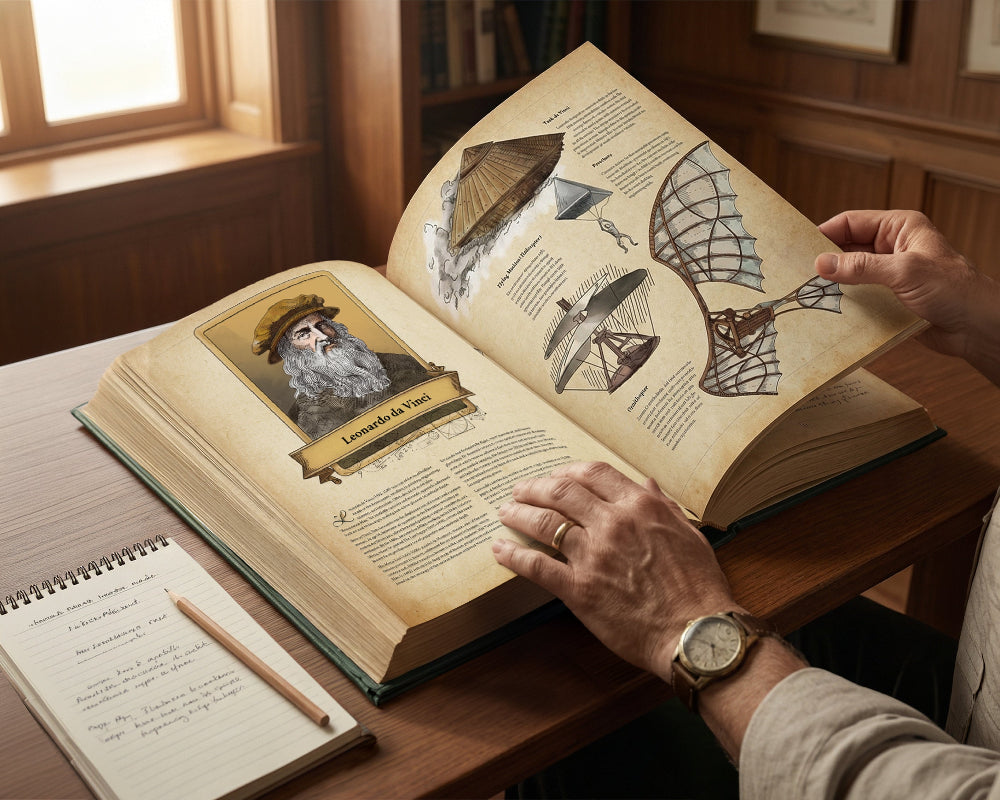
The Codex does something different. It was built in the exact visual tradition that Leonardo da Vinci used in his notebooks — the tradition of the exploded diagram, the annotated cross-section, the drawing that explains a machine from the inside out. Every invention in its 350 pages is shown the way the people who built it would have drawn it.
This is not a book about history. It is a book that puts you inside it.
What it actually feels like to hold it

The reviews of The Codex share a pattern that is almost uncanny.
People describe opening it and not being able to put it down. They describe the feeling of holding something that seems like it shouldn't exist — a manuscript that looks ancient but covers the internet, artificial intelligence, and space exploration. They describe showing it to someone who was walking past, and that person sitting down.
One buyer called it "stumbling upon Leonardo's private journals." Another said it was "an heirloom piece to pass down to grandkids." A third said he would rate it 6 out of 5 if he could.
None of them are describing a coffee table book. They are describing the experience of holding a physical object that makes history feel immediate, tangible, and — most importantly — connected.
Because that is what the Da Vinci visual language does. It does not just illustrate. It explains. And when you see how a crossbow generates mechanical advantage, and then turn the page to see how that same principle of mechanical advantage becomes a steam engine, and then a combustion engine — you are not reading history. You are watching it think.
150 inventions. One continuous story. No gaps.
Most illustrated histories are curated. They pick the famous moments and skip the connective tissue.
The Codex does not curate. It sequences.
It begins with fire — the first human technology, the invention that separated our ancestors from every other species — and builds forward, invention by invention, each one shown in its relationship to what came before and what it made possible.


Early Stages: Fire, settlements, basic tools, the first weapons, textiles. The foundations that made everything else conceivable.
Ancient Period: Pythagoras, Archimedes, Avicenna, the wheel, aqueducts, Hippocrates. Not as dusty names in a timeline — as active minds shown through their actual work.
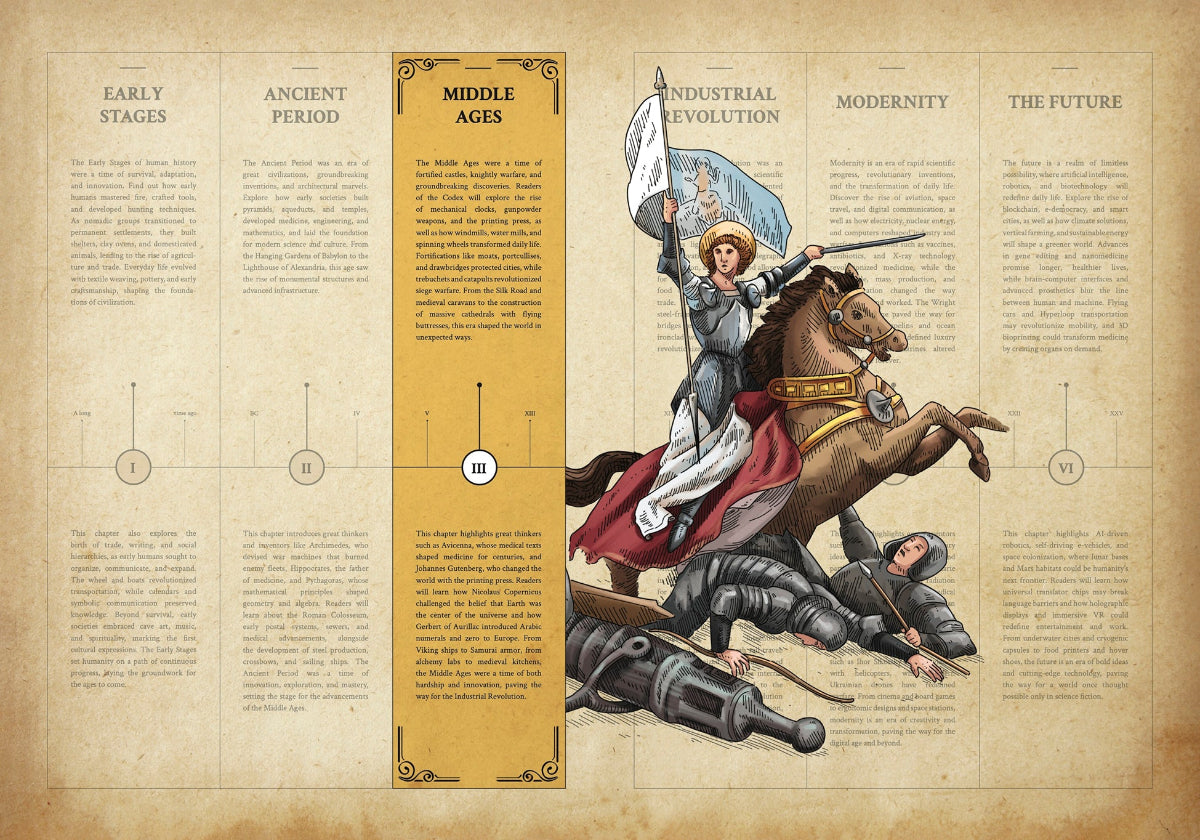
Middle Ages: The compass, the crossbow, catapults, Gutenberg's press, da Vinci's flying machines, Copernicus. The era history calls the Dark Ages — revealed as the most explosively inventive period before the Industrial Revolution.
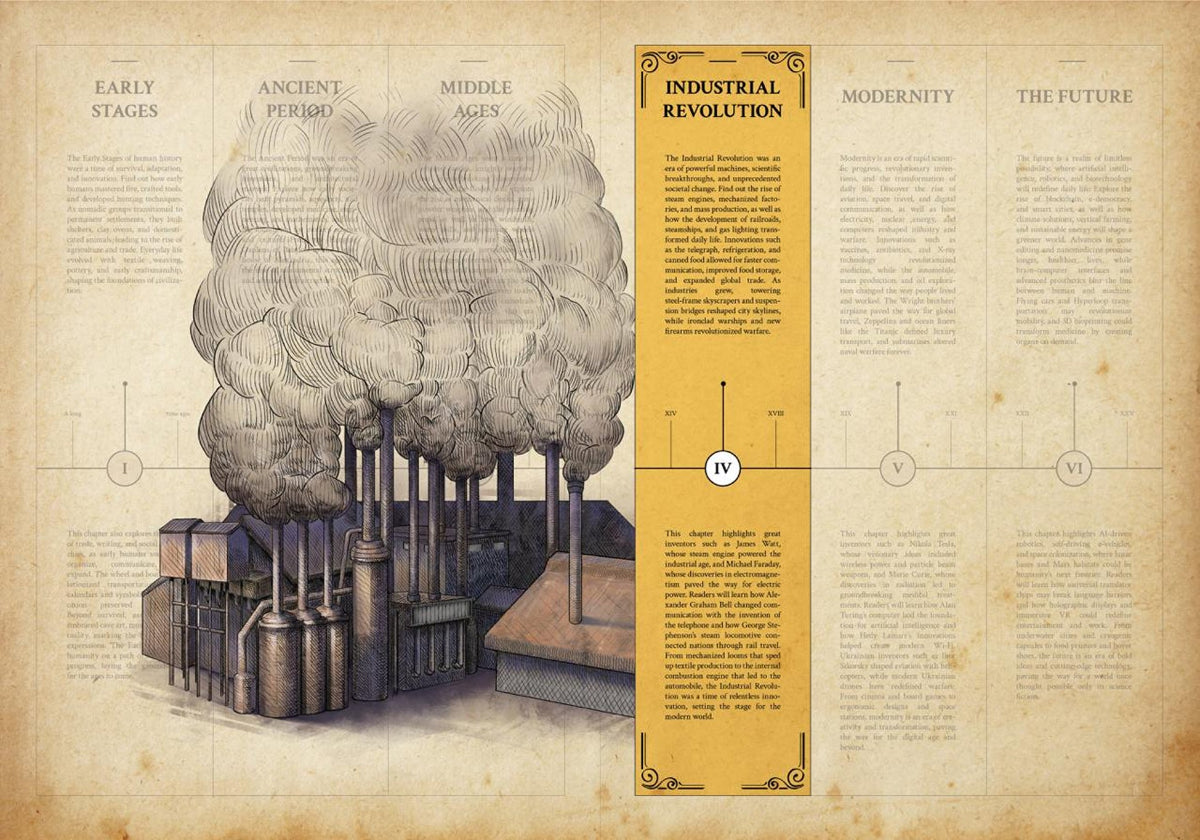
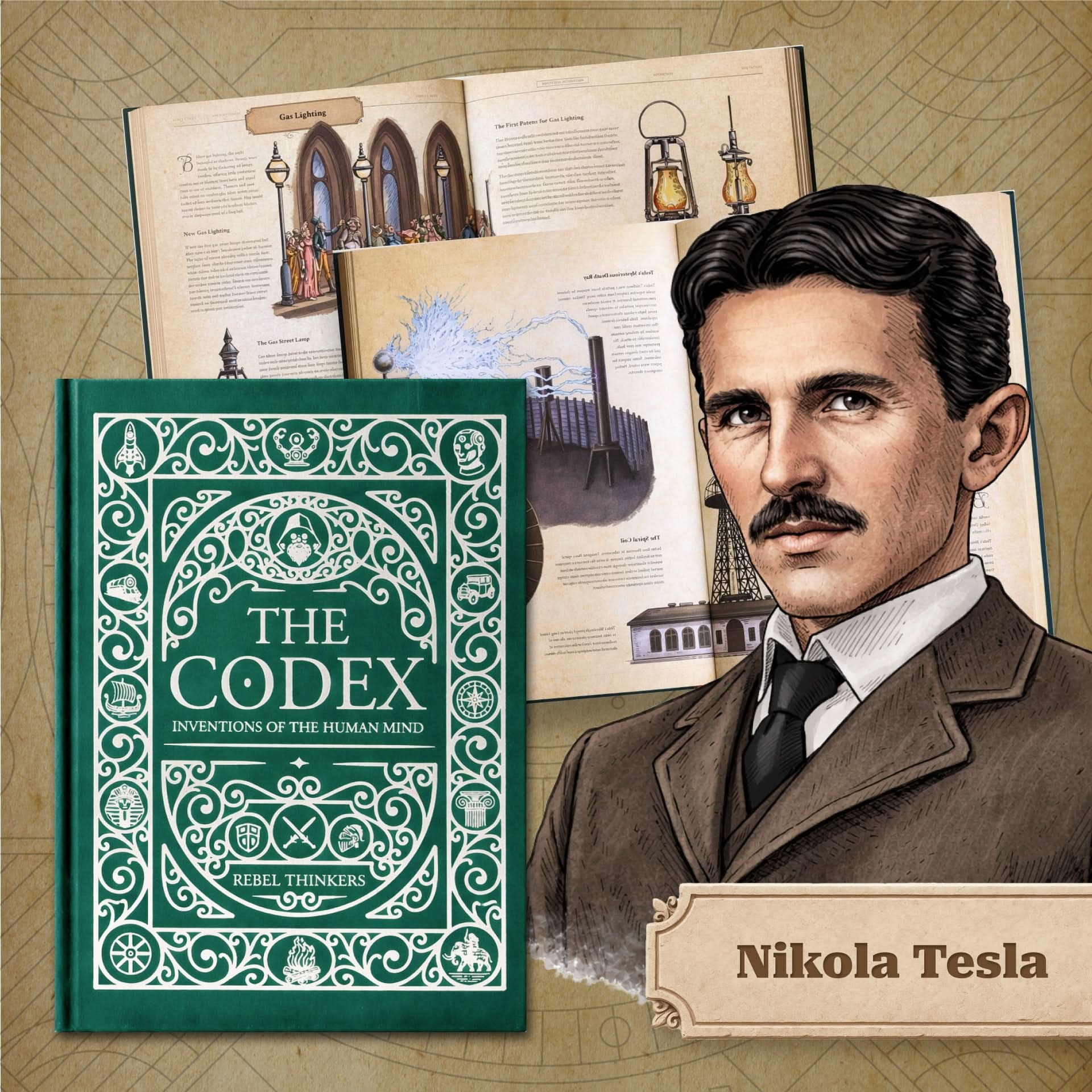
Industrial Revolution: Newton, Watt, Faraday, Tesla, Bell, Stephenson. The 120 years that produced more change than the previous five thousand. Every machine shown in full mechanical cross-section.
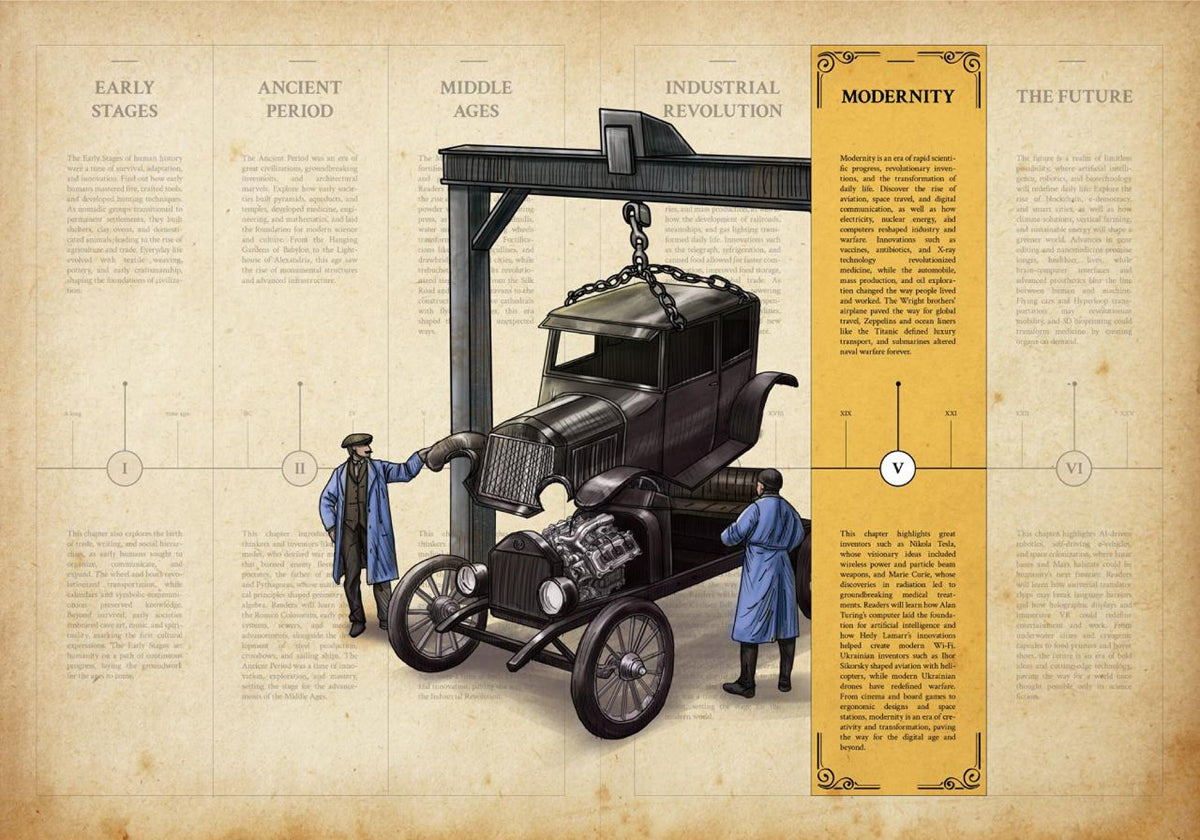
Modernity: Einstein, Marie Curie, the Ford Model T, radar, nuclear energy, television, the computer, vaccines. The 20th century as a cascade of consequences.
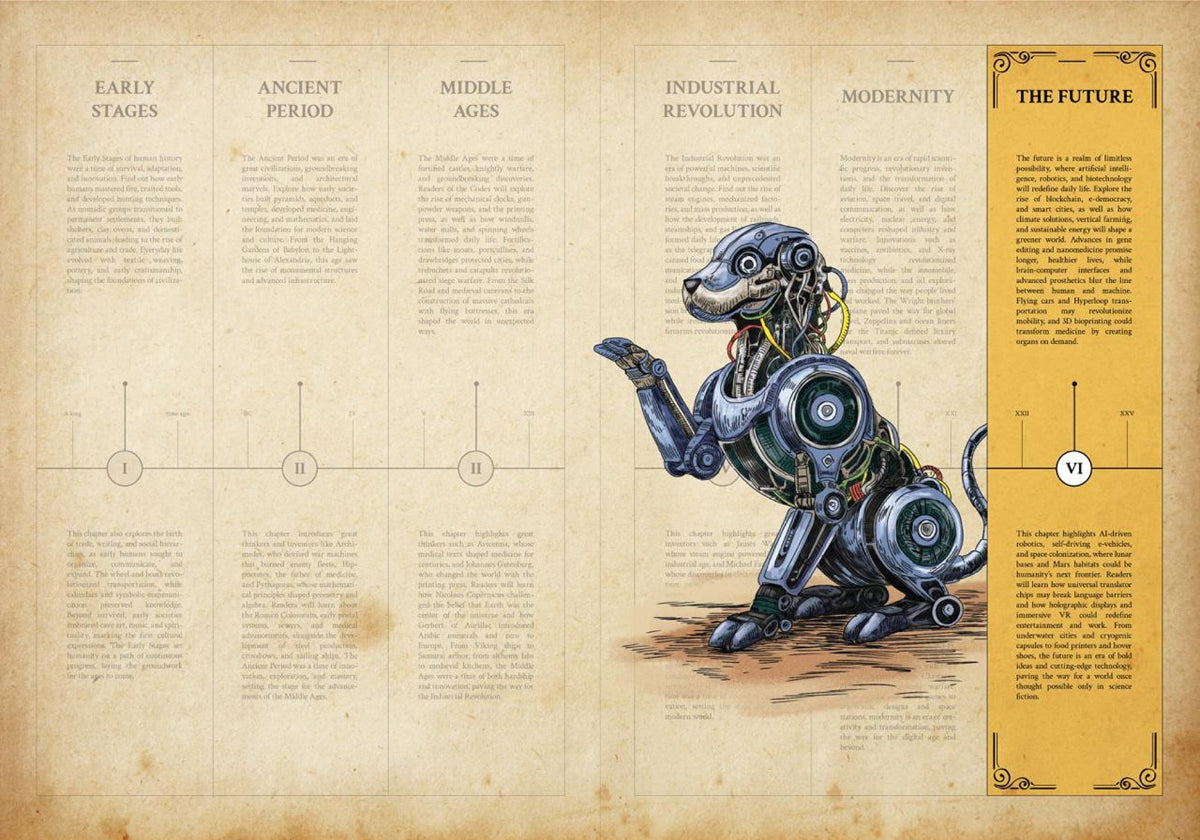
The Future: Artificial intelligence, gene editing, smart cities, space habitation, robotics. The inventions already arriving — treated with the same historical seriousness as the wheel.
When you read it this way — chronologically, causally — you do not just learn what was invented. You understand why it had to be.
"It looks like an old medieval book, but it has all the inventions right in every detail. It's a really different feeling having this book in hand instead of looking something up on the internet. This book works even without internet and electricity. And the illustrations are much better than a lot of internet sides."
Joey M., verified buyer, Boston, USA
The mythology behind it — and why it matters
The Codex has an origin story that is as layered as the book itself.
The Rebel Thinkers team built the narrative of the book around a secret: throughout history, the greatest minds — Archimedes, Newton, Copernicus, Tesla, Einstein — were part of a hidden brotherhood called The Masters. Meeting in private, driven by a shared mission to understand and preserve the mechanisms of the universe, they created a forbidden chronicle of humanity's most transformative inventions.
The Codex is that chronicle. Brought into the open by the faction within The Masters who believed the knowledge belonged to everyone — the Rebel Thinkers.
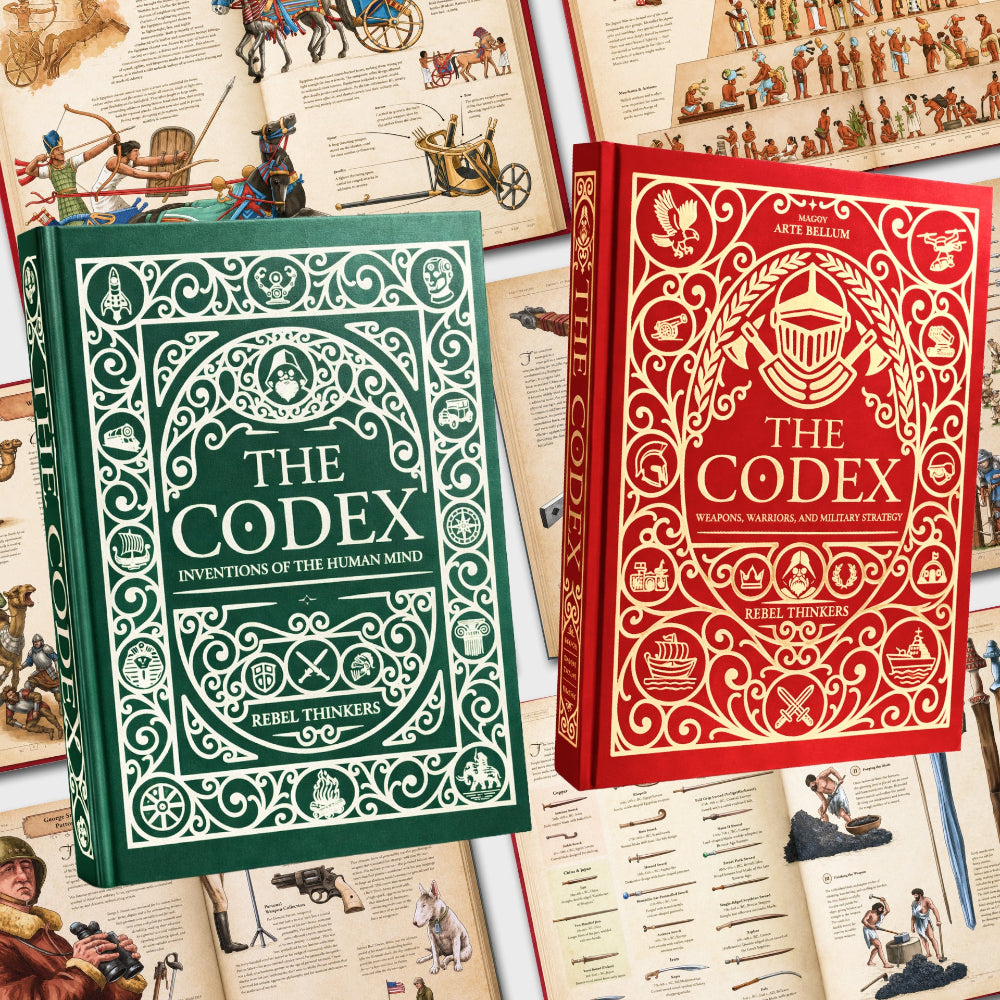
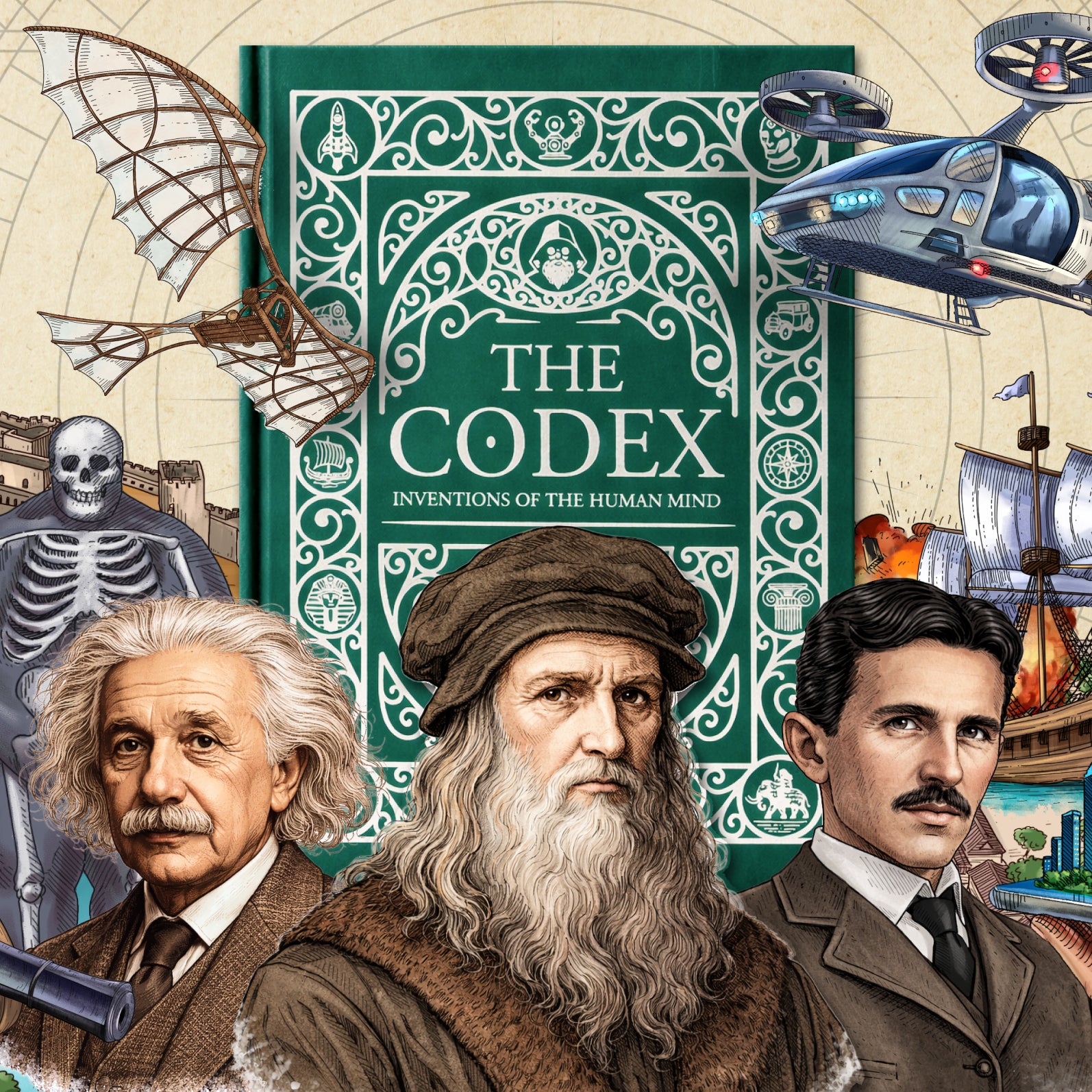
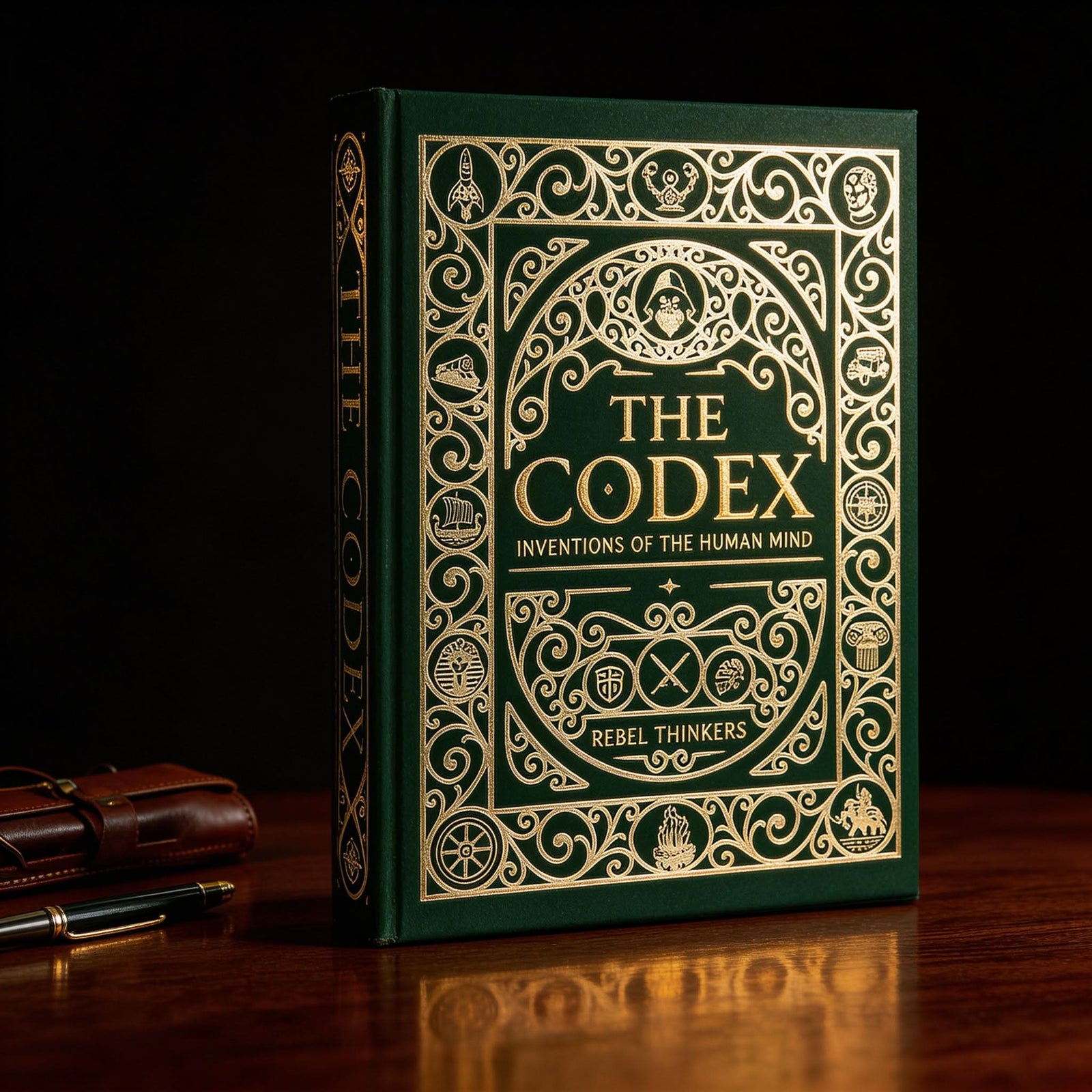
It is a mythology. But it is a mythology built on real history, real inventors, and real illustrations that contain genuine engineering knowledge. The cover — dark green, foil-stamped, with a knight's helmet, a compass, a ship, and a train engraved in its ornamental borders — is designed to look exactly like the artefact it claims to be: a document that was never supposed to reach ordinary hands.
For a person who loves history, this is the deepest possible compliment. The Codex was made to look and feel like a primary source. Because the team that made it — three friends from Kyiv and twelve illustrators working through a war — believed that is exactly what it deserves to be treated as.
- 328+ Pages Across 6 Eras
- Every invention illustrated in the Da Vinci style: cross-sections, annotations, mechanical diagrams
- Researched and verified by historians — not illustrated imagination but documented reality
- 14×10in. format — larger than A4, designed to make illustrations feel alive at full scale
- 160gsm medieval paper— the weight and texture of a manuscript, not a magazine

The Codex is a MUST HAVE. The internet is full of ambiguity — this is researched and verified historical facts. It looks like a medieval codex, but it has all the inventions right in every detail. Big book, excellent quality, good binding, great haptic feeling. A really different feeling having this book in hand instead of looking something up online.
I received the book a few days back and it is just a unique piece of art. The huge amount of work, love and detail clearly shows in each page. It is one of the few books that I'd like my grandchildren to inherit as an ageless classic. Congratulations to the team — a clear display of Ukrainian craftsmanship and entrepreneurship.


The Codex: Inventions of the Human Mind
150 inventions and inventors. 350 pages. 12 Ukrainian artists. The complete visual history of human invention — from fire to artificial intelligence — drawn in the tradition of Leonardo da Vinci's notebooks.
- 5.0 ★ ★★★★ — 55 verified reviews
- 17,500+ Copies delivered worldwide
- Arrives in 2-5 Days!
Questions from History Readers
Is this genuinely informative, or is it primarily visual? I've been burned by beautiful books that are shallow.
The most common thing history enthusiasts say after receiving The Codex is that it exceeded their expectations for depth — and they had already set them high. The visual method is not decoration. Every illustration is built on historical research, verified with historians, and designed to explain the mechanism rather than represent it. One buyer described it as the difference between reading that the printing press changed everything and actually understanding how it worked. That said: it is not a footnoted academic text. It is a visual encyclopedia. If you want citations and bibliography, this is not that. If you want to finally understand how a steam engine, a crossbow, or a Tesla coil actually worked — this is exactly that.
How does the Da Vinci style actually work as a method? Is it gimmick or substance?
It is substance. Leonardo da Vinci did not draw machines in the medieval manuscript style because it was beautiful. He used exploded views, cross-sections, and annotated diagrams because it was the most efficient way to show how a three-dimensional mechanical object works on a two-dimensional page. The Codex uses the same logic. The Tesla coil drawn like a 1490 manuscript illustration is not ironic — it is the clearest possible way to show how alternating current is generated. The aesthetic and the method are the same thing.
Does it cover non-Western inventors and inventions?
Yes, deliberately. Avicenna's contributions to medicine, Zhang Heng's seismograph and astronomical instruments, the Islamic Golden Age's mathematical foundations, Chinese inventions including gunpowder and the compass — these are documented alongside the more familiar European figures. The content plan covers 150 inventions across civilisations, not a Western canon.
Is this a limited edition? Should I order now?
The Codex has sold out twice since its Kickstarter. The current print run is available now. Previous runs had no confirmed reprint timeline between sellouts — there were gaps of several months. If you are considering it, the current run is available and shipping within 3–8 business days worldwide. We cannot confirm when the next print run will happen.