
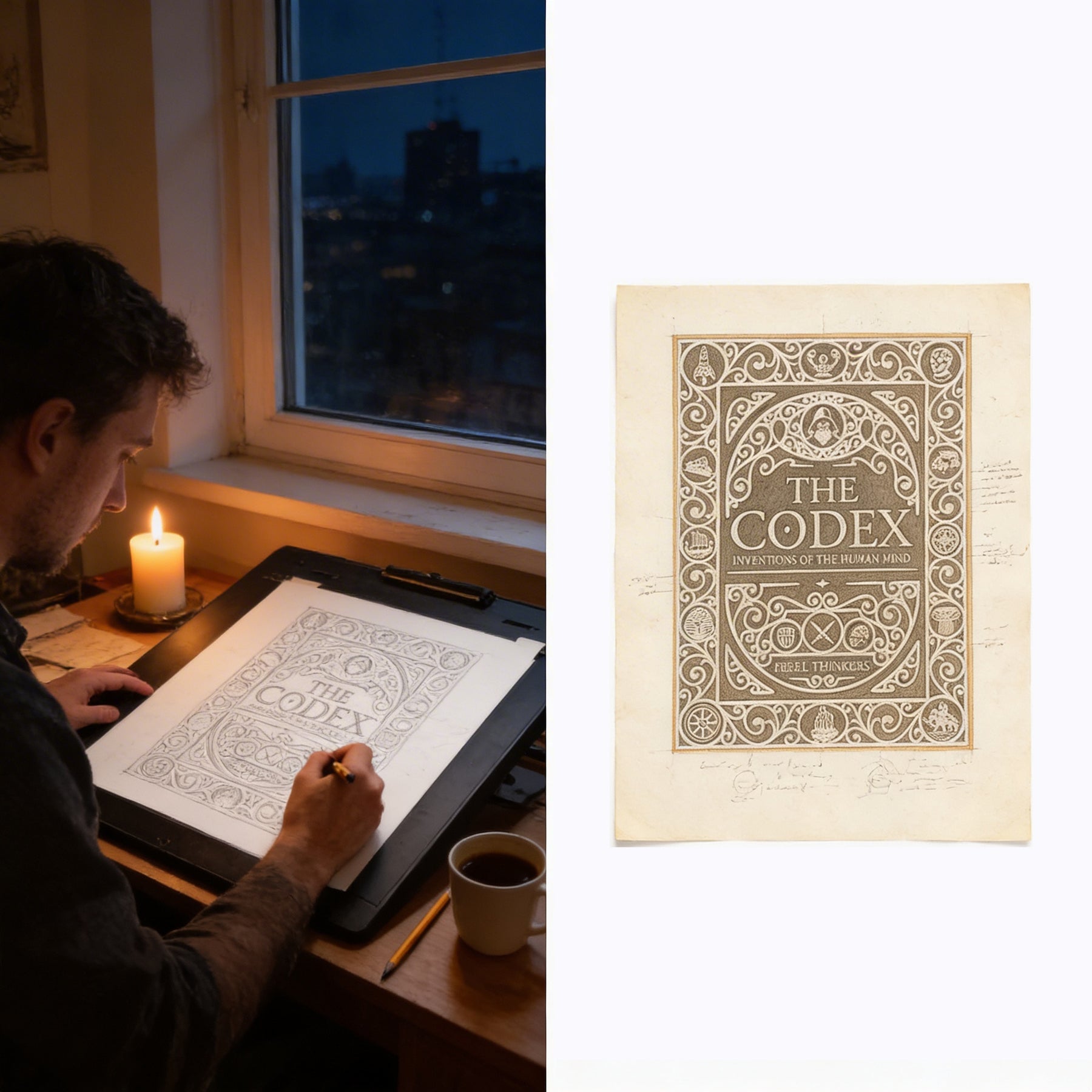
It started with a frustration
Three friends — Vlad Khvyshchuk, Nazar Ozhho, and Danylo Ozhho — had grown up loving history. Not the textbook version. The real thing: the mechanisms behind inventions, the decisions behind battles, the figures that got written out of the standard curriculum.
They kept looking for a book that treated history the way it deserved to be treated. Something that combined the depth of a serious encyclopedia with the visual intelligence of Leonardo da Vinci's notebooks. Something that didn't talk down to the reader.
They never found it. So they built it.
"We wanted the book we couldn't find. Deep enough to surprise someone who already knows the subject. Beautiful enough to earn its place in the room permanently."
Nazar Ozhho, co-founder — Rebel Thinkers
The illustration system — why it looks the way it does
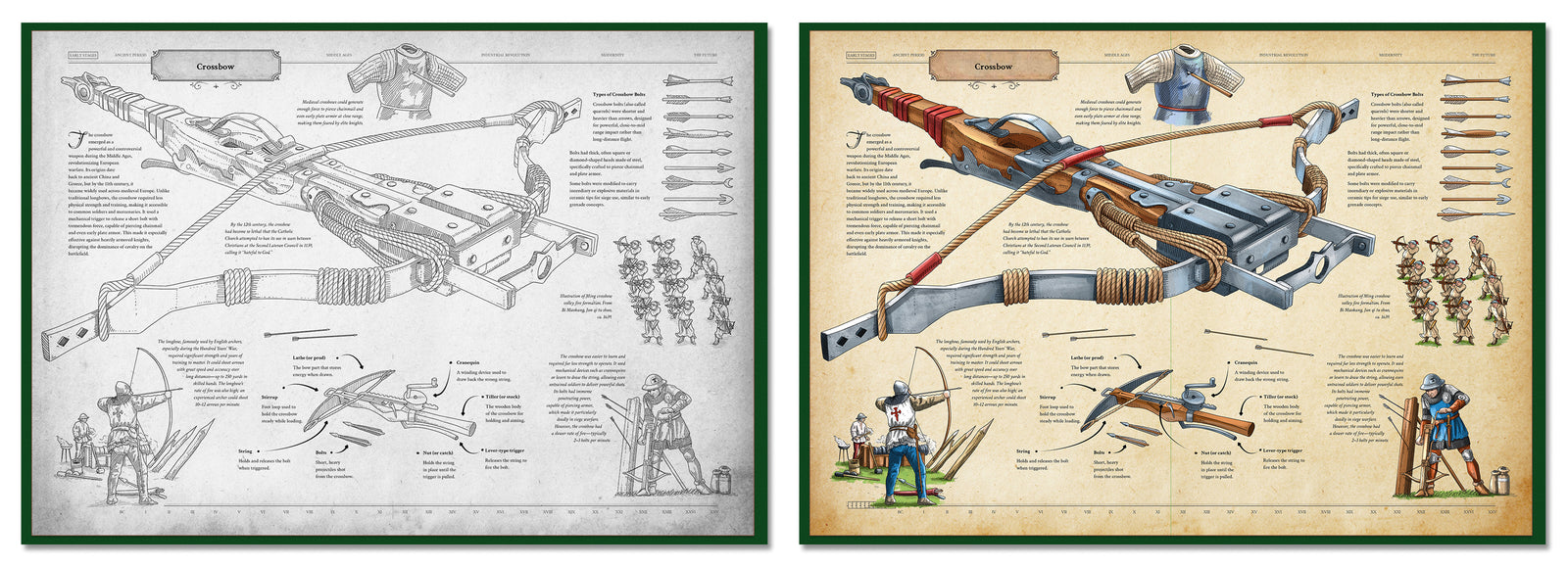
Every illustration in The Codex follows a single rule inherited directly from Leonardo da Vinci: the drawing is the explanation. No labels inside illustrations. No callout arrows. No text overlaid on the image. The visual itself has to communicate the mechanism — the cross-section, the exploded view, the multiple-angle perspective.
This is harder than it sounds. A labeled diagram can cheat. You can draw something approximate and write what it is. A pure visual explanation has to be accurate enough that the reader understands what's happening without any text support. Every mechanism has to be understood before it can be drawn.
Each illustration begins with historical research. The illustrator studies the primary source material — original technical drawings where they exist, archaeological records, period documentation. Only after that research is complete does the drawing begin.
12 illustrators. One visual language.
The Codex is drawn by twelve Ukrainian illustrators — each specializing in different periods and subject matter. The challenge with a team this size is consistency. An illustrated book that looks like twelve different people made it isn't a book. It's an anthology.
Maintaining a unified visual language across 900+ illustrations required a detailed house style — line weight, hatching technique, perspective conventions, how mechanisms are shown in cross-section, how human figures relate to the objects around them. Every illustration goes through an art direction review before it's approved.
The result is a book where a spread on Roman siege weapons and a spread on a Tesla alternator feel like they came from the same hand. Because in terms of visual logic, they did.
Made during wartime
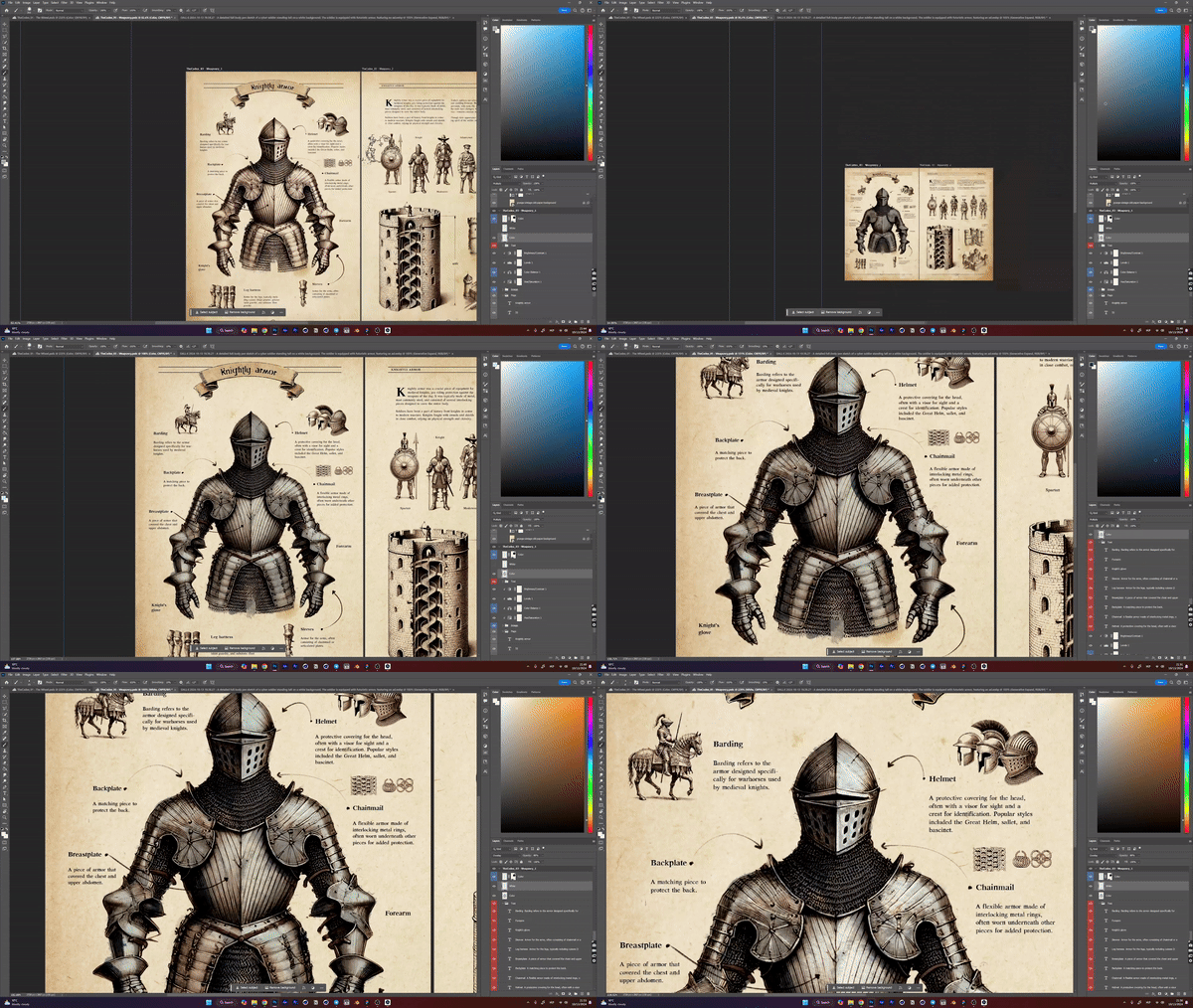
The Codex of Inventions was completed while Ukraine was at war. This is not a marketing detail. It is a structural fact about what the book required to exist.
Illustrators worked through power cuts. Sessions were interrupted by sirens. Deadlines were missed and remade as circumstances changed. The team relocated, adapted, and continued. The work kept going because stopping felt like the wrong answer to what was happening around them.
There is something in that context that changes how the book reads — or should, once you know it. 900+ illustrations of human ingenuity across five thousand years of history, completed by people living inside a moment that was testing exactly that ingenuity. The subject and the circumstance were not separate things.
"Stopping felt like the wrong answer. So we kept drawing."
Vlad Khvyshchuk, co-founder and lead illustrator
The paper, the binding, the physical object
Most illustrated books are printed on coated paper — smooth, bright white, designed to make colors pop on screen and in catalog photography. It looks impressive in a thumbnail. In person it feels cold. Clinical. Like a brochure that costs $60.
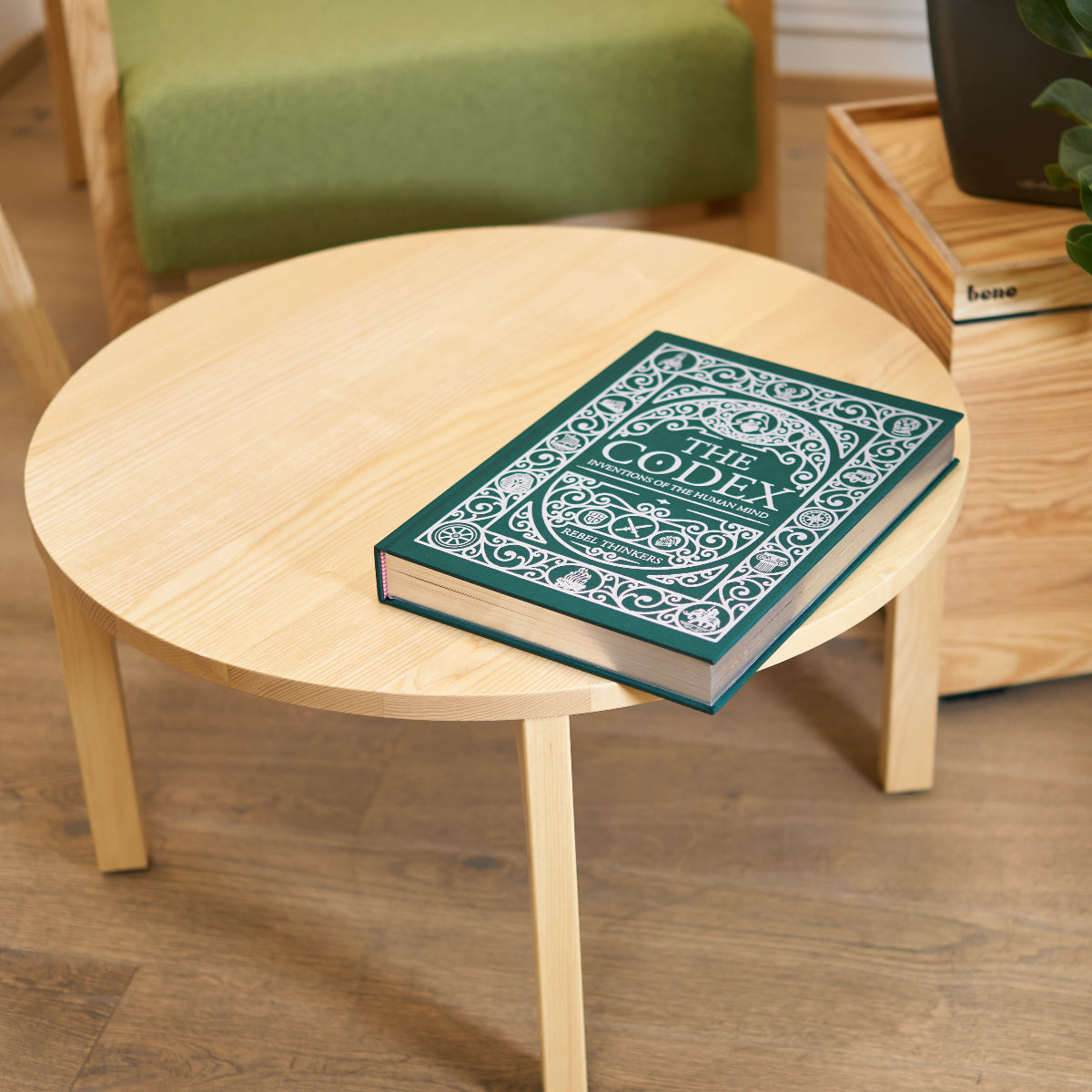
The Codex is printed on 160gsm vintage uncoated archival paper. Uncoated paper absorbs ink differently — the result is warmer, closer to how a manuscript page feels. The weight means pages don't flex when you hold the book open. It has substance in the hand.
The hardcover is foil-stamped. The pages are gold-edged — visible before the book is fully removed from its slipcase. The binding is sewn, not glued. A glued binding cracks. A sewn binding survives decades of use. These are not premium signals. They are premium decisions.
- 160gsm vintage uncoated archival paper — warm, weighted, designed to last
- Foil-stamped premium fabric hardcover — not printed-on, stamped in
- Gold-edged pages — visible the moment the slipcase opens
- Sewn binding — survives decades of use; glued bindings do not
- Collector's slipcase inside a branded double box — protection that communicates value
The editorial process — content that earns trust
The visual system is only half the work. The content underneath it has to be worth illustrating. The Codex was designed from the beginning to cover ground that most popular history books don't reach — deliberately non-Eurocentric, specifically seeking out figures and mechanisms that the standard curriculum skips.
The Islamic Golden Age gets the same depth as the Renaissance. Chinese engineering history is treated with the same seriousness as European industrialization. Zhang Heng, Avicenna, and Al-Jazari sit alongside Leonardo da Vinci, Nikola Tesla, and Isaac Newton — not as footnotes, but as equals in a single narrative of human ingenuity.
Every factual claim in the book is verified against primary historical sources. The illustrations are checked against the research. The research is checked against the illustrations. The standard is simple: if an expert in the period opened this book, nothing should make them wince.

From Ukraine to your shelf — how it ships
Once printed in China to the specifications the paper and binding require, The Codex ships to fulfillment warehouses in the US, EU, UK, Australia, and Canada. The majority of orders arrive within 3–8 days for US and EU addresses.
The packaging was designed as part of the product. The outer branded box protects the slipcase. The slipcase protects the book. Both are designed to be kept. Several buyers have written to say they kept the outer box alongside the book on their shelf — which was the intention.
"I've bought a lot of expensive books. Most of them feel expensive when you pay and ordinary when they arrive. The Codex felt more impressive in person than in any photo I'd seen of it. The paper, the weight, the way the slipcase opens — it's the first book I've owned that felt like it was made by people who cared about every part of it."
"I knew it was going to be good. I didn't expect to spend the first hour just going through the illustrations without reading a word. The linework is extraordinary. You can see how much time went into each page."
"The paper is the first thing you notice when you open it. It doesn't feel like a modern book. It feels like something older and more serious. I've been in publishing for twenty years and the production quality is genuinely exceptional."
Questions about how The Codex is made
Are the illustrations really all hand-drawn, or is digital involved?
The illustrations are hand-drawn and then digitally refined for print — a standard production workflow for premium illustrated publishing. The original artwork is hand-rendered; digital tools are used for color correction and print preparation, not for generating the illustration itself. Every line originates with an illustrator, not a progr
Why use Ukrainian illustrators specifically?
The founding team is Ukrainian, and building with Ukrainian artists was a deliberate creative and ethical decision — not a cost one. The talent level in Ukraine's illustration community is exceptional, and the team had existing relationships with artists whose work matched the visual language The Codex required. The wartime context added a layer of meaning to the collaboration that the founders consider inseparable from what the book is.
What makes 160gsm paper different from a standard illustrated book?
Most illustrated books use 130gsm coated paper — lighter, brighter, optimized for photographic reproduction and catalog photography. 160gsm uncoated archival paper is heavier, warmer in tone, and absorbs ink in a way that suits hand-drawn linework far better than coated stock. It also ages without yellowing the way standard coated paper does. The difference is immediately obvious when you hold both books side by side.
How long did the book actually take to make?
Three years from concept to first print run. That covers research and content development, illustrator selection and house-style development, the illustration of 900+ spreads, editorial review, print specification, and production. The team considers that timeline a minimum for the standard the book required — not an unusually long one.
The book, if you want it

The Codex of Inventions of the Human Min
Three years. Twelve Ukrainian illustrators. 900+ hand-drawn illustrations on 160gsm archival paper. Sewn binding. Gold-edged pages. Built to outlast its owner.
- 350+ pages across 6 chronological eras of human invention
- 900+ original illustrations — no stock art, no digital generation
- 160gsm archival paper, sewn binding, foil-stamped hardcover
- Ships in collector's slipcase inside branded double box, 3–8 days