



Best Military Books: Quick Comparison
Short answer first: here are all 12 books, with who each one suits, the period it covers, its format and its main limitation. Select a title to jump to its full review.
| Book & author | Best for | Period | Format | Main limitation | |
|---|---|---|---|---|---|
The Codex of Military History — Rebel Thinkers |
Seeing the whole of warfare first |
Earliest weapons to future warfare |
Illustrated encyclopedia |
An overview, not a deep study of one war |
|
Weapons and armor up close |
About 5,000 years |
Photo reference |
Objects first, little story |
||
The Face of Battle — John Keegan |
What combat felt like |
1415, 1815, 1916 |
Analytical history |
Three battles, all British armies |
|
The Asian Military Revolution — Peter A. Lorge |
A view beyond Europe |
Gunpowder to the nuclear age |
Academic survey |
Concise and scholarly |
|
Thermopylae — Paul Cartledge |
Ancient warfare and its legend |
480 BC |
History in wide context |
The battle is a small part |
|
The Campaigns of Napoleon — David G. Chandler |
Napoleon as commander |
1796–1815 |
Campaign history |
Over 1,100 pages |
|
1776 — David McCullough |
An easy start on the American Revolution |
1775–1777 |
Narrative history |
One year of the war |
|
The Guns of August — Barbara W. Tuchman |
How WWI began |
Summer 1914 |
Narrative history |
Ends in September 1914 |
|
Stalingrad — Antony Beevor |
One decisive WWII campaign |
1941–1943 |
Campaign history |
Eastern Front only |
|
With the Old Breed — E. B. Sledge |
The Pacific War from a foxhole |
1944–1945 |
Memoir |
One Marine's view |
|
A Bright Shining Lie — Neil Sheehan |
Vietnam, military and political |
1962–1972 |
Biography and history |
Over 800 pages |
|
Black Hawk Down — Mark Bowden |
A modern battle hour by hour |
3–4 October 1993 |
Reconstruction |
One battle, mostly the US view |
Illustrated Military History Books and Encyclopedias
For readers who want to see warfare before reading about it: a whole era on one spread, read in any order and revisited whenever a narrative leaves a gap.

The Codex of Military History
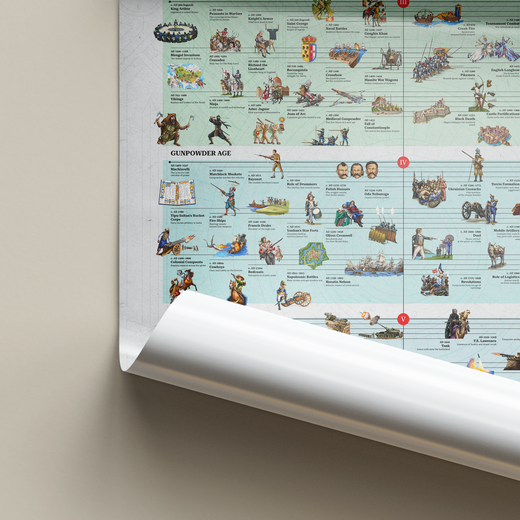
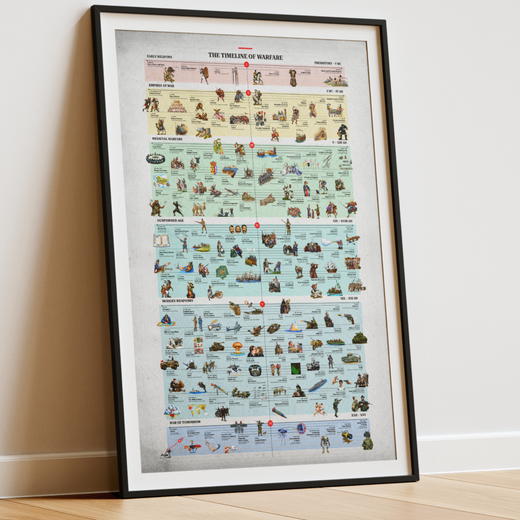
Rebel Thinkers Publishing · about 300 pages. An illustrated encyclopedia of weapons, warriors and military strategy, hand-drawn by Ukrainian artists in a Da Vinci-inspired style.
Why we included it: most military history is told as a continuous story, so you see one war at a time. The Codex works the other way. Each spread puts a weapon, the warriors who used it and the tactics it made possible on the same page, so you take in a whole period at a glance and see how one era led to the next.
It isn't a school textbook: the illustrations show how a battle formation or a siege actually worked, and they are the kind you stop and study. Its stated aim is not to glorify war but to show how it shaped civilization.
What it covers: six eras, from Early Weapons to War of Tomorrow, with weapons, warriors and strategy on every spread. Because each spread stands on its own, you can open it at whichever era you are curious about today and read in any order.
Disclosure: The Codex is published by Rebel Thinkers, the publisher of this guide. Source: publisher's product page.
- Best for
- Readers who want the big picture of how warfare developed before choosing one war to read about in depth.
- Keep in mind
- It's an overview, not a replacement for specialised studies like Beevor's Stalingrad or Chandler's Napoleon; it works best as the map you return to while reading them. The large format belongs on a desk, not in a bag.


Military History: The Definitive Visual Guide to the Objects of Warfare
DK, with the Smithsonian · 448 pages.
Why we included it: it is the strongest example of the other illustrated approach. Where The Codex is drawn and arranged by era, DK is photographic and arranged around objects: real swords, muskets, uniforms and tanks with their specifications, plus cutaway tours of a Roman fort, a medieval castle and a First World War trench. Reading the two side by side shows the difference between seeing what armies used and seeing how they fought.
What it covers: around 5,000 years of weaponry, from ancient arms to modern tanks, jets and helicopters, with a catalog for each period.
Source: DK publisher description (ISBN 9781465436085).
- Best for
- Readers drawn to weapons, armor and military vehicles who want to see them in close detail.
- Keep in mind
- Text is mostly short captions and timelines, so you learn little about why campaigns went the way they did. It is heavy.

Military History Books on How Warfare Changed
These two explain how warfare changed: what fighting felt like for soldiers across five centuries, and how gunpowder reshaped armies far beyond Europe.

The Face of Battle: A Study of Agincourt, Waterloo and the Somme
John Keegan · 1976.
Why we included it: Keegan, a military historian who taught at Sandhurst, asks what most battle histories skip: how men were wounded, what made them stand or run, and how courage held under fire. Setting three battles side by side lets you see what changed over 500 years and what stayed the same about the nature of war.
What it covers: three battles fought by British armies: Agincourt (1415), Waterloo (1815) and the first day of the Somme (1916), seen from the soldier's level rather than the general's map.
Source: Penguin Random House book page.
- Best for
- Readers who want to understand what combat was actually like for the men in the line.
- Keep in mind
- This is not a history of all wars: three battles, all in western Europe, all with British armies. The opening chapter on how history is written is slow going.

The Asian Military Revolution: From Gunpowder to the Bomb
Peter A. Lorge · Cambridge University Press, 2008.
Why we included it: most reading lists tell the gunpowder story from Europe. Lorge argues that gunpowder warfare began in China and that Asian states built powerful armies long before European contact. Historian Jeremy Black picked it for his Five Books list on the history of war for exactly that wider view.
What it covers: gunpowder weapons in China, Japan, Korea, India and Southeast Asia, from medieval China to the nuclear age.
Source: Cambridge University Press catalog; Five Books, Jeremy Black.
- Best for
- Readers who know the European story of gunpowder and want the region where it was invented.
- Keep in mind
- It's a short academic survey of a huge region, about states, armies and technology rather than battle stories, so it reads like a university text.


Military History Books on Ancient Warfare and Historic Campaigns
For readers who already know which era pulls them in: each book goes deep into specific military campaigns, from ancient Greece to the American Revolution.

Thermopylae: The Battle That Changed the World
Paul Cartledge · 2006.
Why we included it: Thermopylae is the most famous last stand in history, and most readers know it through films. Cartledge, a Cambridge historian of Sparta, separates what the ancient sources actually say from the legend, and explains why a heavily outnumbered Greek force mattered so much even though it lost.
What it covers: Xerxes' invasion of Greece in 480 BC, Leonidas and his Spartans at the pass, and the battle's long afterlife in Western culture.
Source: Overlook Press (US) and Macmillan (UK) publisher pages.
- Best for
- Readers who want the real history behind the most famous battle of ancient warfare.
- Keep in mind
- It is a broad study rather than a narrow tactical reconstruction. The battle itself fills a small part of the book, and readers who want only military detail may find the chapters on Spartan society and legacy long.

The Campaigns of Napoleon
David G. Chandler · 1966.
Why we included it: it is still the standard single-volume study of Napoleon Bonaparte as a commander. Chandler, who lectured at Sandhurst, explains how Napoleon's system of war worked, why it won so often and why it eventually failed. Historian Andrew Roberts includes it in his Five Books list of the best books on Napoleon.
What it covers: Napoleon's campaigns from Italy in 1796 to Waterloo in 1815, with chapters on his planning, movement and army organisation, and detailed maps.
Source: Scribner / Simon & Schuster; Five Books, Andrew Roberts.
- Best for
- Readers ready for a serious study of how Napoleon planned and fought.
- Keep in mind
- At over 1,100 pages it is a commitment, and it stays with military operations. There is little on the French Revolution's politics or soldiers' daily life, so it works better as a second or third book than a first.

1776
David McCullough · 2005.
Why we included it: it is the easiest way into the American Revolution, a #1 New York Times bestselling history that reads like a story without losing the history. McCullough follows both Washington's inexperienced army and the British side, showing how close the cause came to collapse before patriotism, endurance and luck held it together.
What it covers: one year of the Revolutionary War, from the siege of Boston in 1775, through the defeats around New York, to Trenton and Princeton in early 1777.
Source: Simon & Schuster book page.
- Best for
- Readers who want an accessible, story-driven start on the American Revolution.
- Keep in mind
- It covers a single year: Saratoga and Yorktown fall outside it, and the Civil War is a separate conflict it doesn't touch. Analysis is light compared with academic histories.


Military History Books on World War I and World War II
There are three good ways to read about the world wars: a narrative of how a war began, a deep study of one campaign, and a memoir by someone who fought. Here is a strong example of each.
If your interest is the Western Front of the Second World War, two classics do the same jobs from a different angle: Cornelius Ryan's The Longest Day reconstructs D-Day in Normandy from hundreds of interviews, and Stephen E. Ambrose's Band of Brothers follows one US Army paratrooper company from training to the end of the war.

The Guns of August
Barbara W. Tuchman · 1962 · Pulitzer Prize.
Why we included it: no book explains better how the First World War started. Tuchman shows how plans drawn up years earlier, and the men in charge, from the Kaiser to a young Winston Churchill at the Admiralty, pushed every power into a long war that nobody expected.
What it covers: the decisions of summer 1914 and the first month of fighting up to the Battle of the Marne: Germany's invasion of Belgium and France, Britain's entry, the Russian front and naval episodes.
Source: Penguin Random House book page.
- Best for
- Readers who want to understand why the First World War began and why it didn't end quickly.
- Keep in mind
- It covers only the opening of the war, not the whole conflict. Later scholarship has revised some of Tuchman's judgments, so read it as a brilliant narrative rather than the final word.

Stalingrad (US edition: Stalingrad: The Fateful Siege, 1942–1943)
Antony Beevor · 1998 · Samuel Johnson Prize.
Why we included it: it is the campaign study readers recommend most often, and it shows what one battle can explain about a whole war. Beevor built it from German and Soviet archive material and soldiers' letters: Hitler's refusal to let his army break out, Soviet executions of their own men, and the Nazi defeat where the tide of the war turned.
What it covers: the Eastern Front from the moment Germany invaded the Soviet Union in 1941 to the surrender of the Sixth Army in February 1943.
Source: Penguin book page.
- Best for
- Readers who want one decisive Second World War campaign in depth rather than the whole war.
- Keep in mind
- It's the Eastern Front only, with no Normandy or Pacific, so it isn't a general history of the war. It is detailed and grim to read.

With the Old Breed: At Peleliu and Okinawa
E. B. Sledge · 1981 · Memoir.
Why we included it: it is the most honest firsthand account of the Pacific War, written partly from notes Sledge kept hidden in his pocket New Testament. There is no easy heroism here: fighting Japanese soldiers in mud and heat, losing friends, and coming home a survivor who knew what victory had cost.
What it covers: Sledge's service as a mortarman with the 1st Marine Division at Peleliu (1944) and Okinawa (1945).
Source: Presidio Press / Random House book page.
- Best for
- Readers who want to know how the Pacific War felt to the man in the foxhole.
- Keep in mind
- This is one man's personal perspective, not a history of the Pacific War. There is little on strategy, it doesn't cover Iwo Jima, and some passages are graphic and heart-wrenching.


Modern Military History Books: Conflicts Since 1945
This section covers wars fought since 1945, not books that happen to be new. The two picks show opposite scales: a guerrilla war followed over a decade, and one battle followed through one night.

A Bright Shining Lie: John Paul Vann and America in Vietnam
Neil Sheehan · 1988 · Pulitzer Prize.
Why we included it: it explains the Vietnam War as a military and political story at once. Through the career of one adviser, Sheehan shows why a powerful conventional army struggled against a guerrilla enemy, and how official optimism hid the problem from Washington. Still insightful after Iraq and Afghanistan.
What it covers: the American war in Vietnam from 1962 to 1972, through John Paul Vann, a US Army officer and later civilian adviser who became one of its sharpest critics.
Source: Pulitzer Prize page; Random House book page.
- Best for
- Readers who want to understand why the Vietnam War went the way it did, not only what happened.
- Keep in mind
- It runs over 800 pages, part of it is biography including Vann's private life, and the Vietnamese experience gets less space than the American one.

Black Hawk Down: A Story of Modern War
Mark Bowden · 1999.
Why we included it: it shows what a general history can't. A history of a war covers years in a chapter; Bowden spends a whole book on one night, rebuilt from interviews, radio transcripts and video, so you follow tactical decisions made in seconds. A New York Times bestselling account.
What it covers: the Battle of Mogadishu, 3–4 October 1993, when a raid by US Army Rangers and the Delta Force special forces unit became an all-night fight after two Black Hawks were shot down. Eighteen Americans and hundreds of Somalis died.
Source: Grove Atlantic book page.
- Best for
- Readers who want a modern battle reconstructed minute by minute.
- Keep in mind
- It covers one battle over about a day. The background in Somalia is brief, and although it includes Somali voices, it is told mostly from the American side.


Editorial transparency
How We Selected These Military History Books
To pick the best military history books for this guide, we chose each one for a different reading job, so the list covers different periods, formats and depths. The criteria: relevance to military history, historical scope, use of sources, clarity for a non-specialist and format.
We cross-checked our picks against book recommendations by historians on Five Books (Hew Strachan, Jeremy Black, Michael Howard, Antony Beevor, Andrew Roberts, James Holland and historian Lucy Betteridge-Dyson) and reader discussions, rather than best sellers lists. Naval history, biography and historical fiction deserve their own lists.
Our assessment is based on publisher descriptions, tables of contents and available excerpts. We have not read every title cover to cover.
Military History Encyclopedia vs. Narrative History: Which Should You Choose?
Choose a reference encyclopedia when you want breadth and the freedom to read in any order. Choose a narrative history when you want one war in depth, read from start to finish. They answer different questions, and they work best together.
Neither format is better on its own: an encyclopedia without a narrative stays general, and a narrative without a map can leave you lost between campaigns.
A reference work, whether a classic encyclopedia of military history like Dupuy's or an illustrated one like The Codex, gives you the map: what happened when, and how one era grew out of the last. A narrative like Stalingrad or The Guns of August gives you the experience of one stretch of that map, with its people, causes and turning points.
Illustrations matter most in the first format: a good drawing of a formation or a weapon explains in seconds what a paragraph struggles to. That is why many readers keep an illustrated reference open beside the narrative they're reading.
| Encyclopedia | Narrative history | ||||
|---|---|---|---|---|---|
How you use it |
Browse and look things up |
Read from start to finish |
|||
Breadth |
Many eras and wars |
One war, campaign or person |
|||
Reading order |
Open at any page |
Chapter by chapter |
|||
Depth |
An overview of each topic |
Detail, causes and people |
|||
Illustrations |
Central: show how things looked and worked |
Supporting: maps and photos |
How to Choose Your First Military History Book
Answer three questions. Every book mentioned here is covered above.

1. Which topic pulls you in? A specific war points to its section: Napoleon to Chandler, the First World War to Tuchman, Vietnam to Sheehan, D-Day to The Longest Day. Not sure yet? Start broad with The Codex or the DK guide.
2. How deep do you want to go? For a first read, choose 1776 or Black Hawk Down. Ready for a commitment? Stalingrad or The Campaigns of Napoleon reward it.
3. Which format suits you? Like to browse? Pick an illustrated reference. Prefer a story with a beginning and an end? Pick a narrative history. Want one voice? Pick a memoir like With the Old Breed, or Band of Brothers for one company's war.
Most readers' best books on military history end up mixing all three formats, because good military books of different kinds explain each other.
Frequently Asked Questions
Are military strategy books the same as military history books?
No. Military history books explain what happened in past wars and why. Strategy books, such as Sun Tzu's The Art of War or Carl von Clausewitz's On War, offer theories of how war should be fought; On War, a demanding work of military intellect, is still studied at war colleges. Strategy draws on history, and history tests strategy, so the two complement each other.
Can military memoirs replace a general history of a war?
No. A memoir gives one person's firsthand experience: what they saw, feared and remembered. Even the memoirs of generals rarely explain the other side or the wider war. Read a memoir like With the Old Breed alongside a general history, and each makes the other clearer.
Do I need to read military history books in chronological order?
No. Start with the period that interests you most; interest is what keeps you reading. An illustrated reference or a timeline helps you place each book in the bigger picture, so jumping from the Napoleonic Wars to Vietnam doesn't leave you lost.
How to distinguish a new military history book from a new edition?
Check the copyright page. A new book has a single recent date; a new edition lists the original year plus the edition date, and often says "revised" or "with a new preface". The ISBN changes with each edition, and the same book may carry different titles in the US and UK, as Beevor's Stalingrad does.
What should I check in a military history book's sources and bibliography?
Look for primary sources such as archives, letters, diaries and official records, not only other books. Check whether the author used sources from more than one side, whether the notes show where specific claims come from, and whether the bibliography includes recent scholarship. Good history written for general readers still shows its evidence.