



I collect illustrated hardcovers, and over the years I've built a short list of things I check before a book earns a spot on my shelf. It has nothing to do with hype or how many people backed something online. It comes down to a handful of details: the paper, the binding, the art, and whether the thing you're reading actually holds your attention once the packaging is out of the way.
Most books fail at least one of these. Some have gorgeous covers and cheap paper. Some have thick paper and lazy, generic art. Some look incredible in photos and fall apart the moment you actually open them. So when I sit down to review something, I go through it piece by piece instead of just giving a general impression.
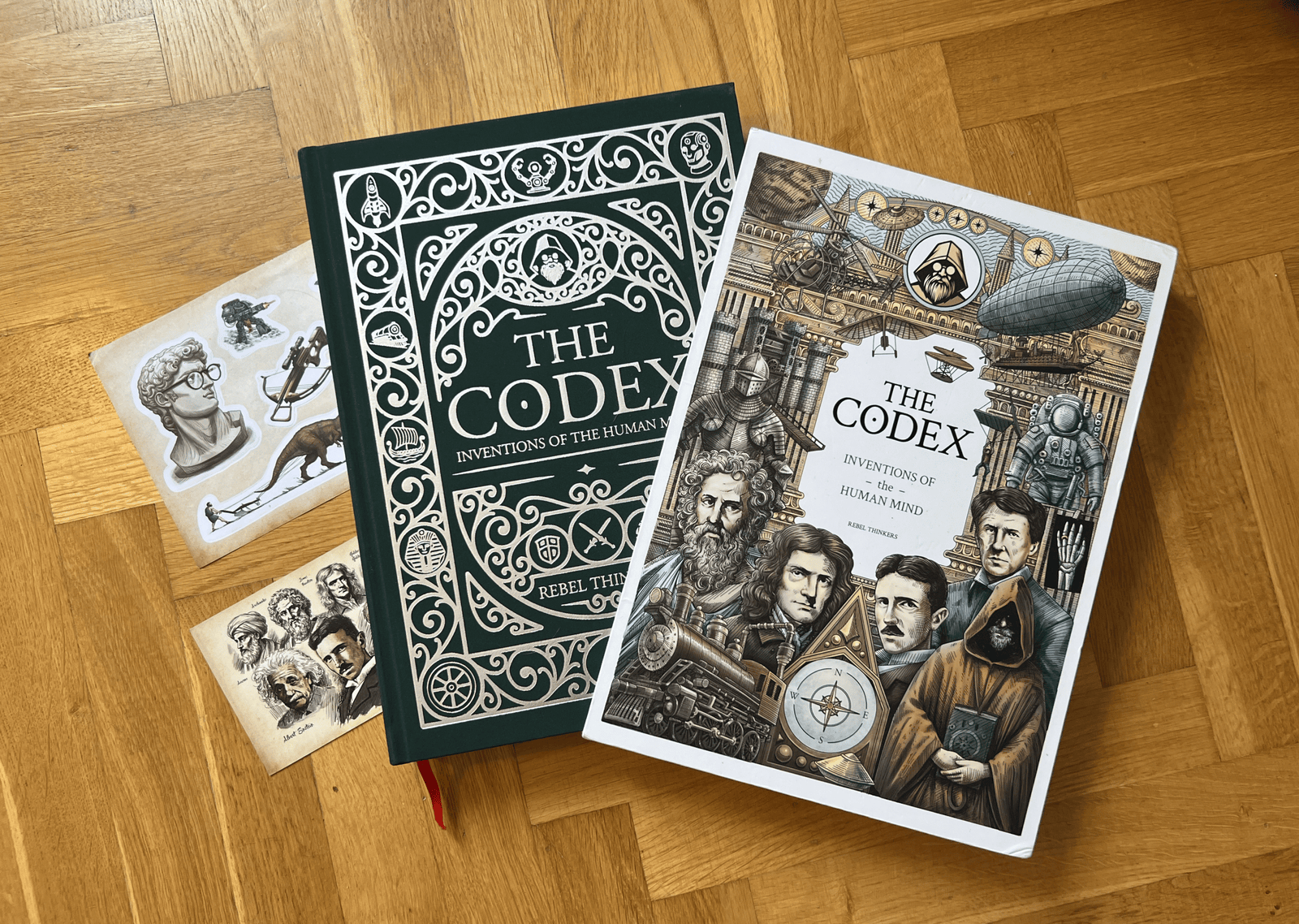
I first saw The Codex: Inventions of the Human Mind at a friend's place, sitting open on his coffee table. I picked it up, flipped through a few pages standing in his living room, and noticed it was heavier and more detailed than most books in this category. I didn't buy it that night — I went home, found it on the website, and let it sit in a tab for about a week before I actually ordered it.
Here's the full breakdown, section by section.

First Impressions: Turning the Pages
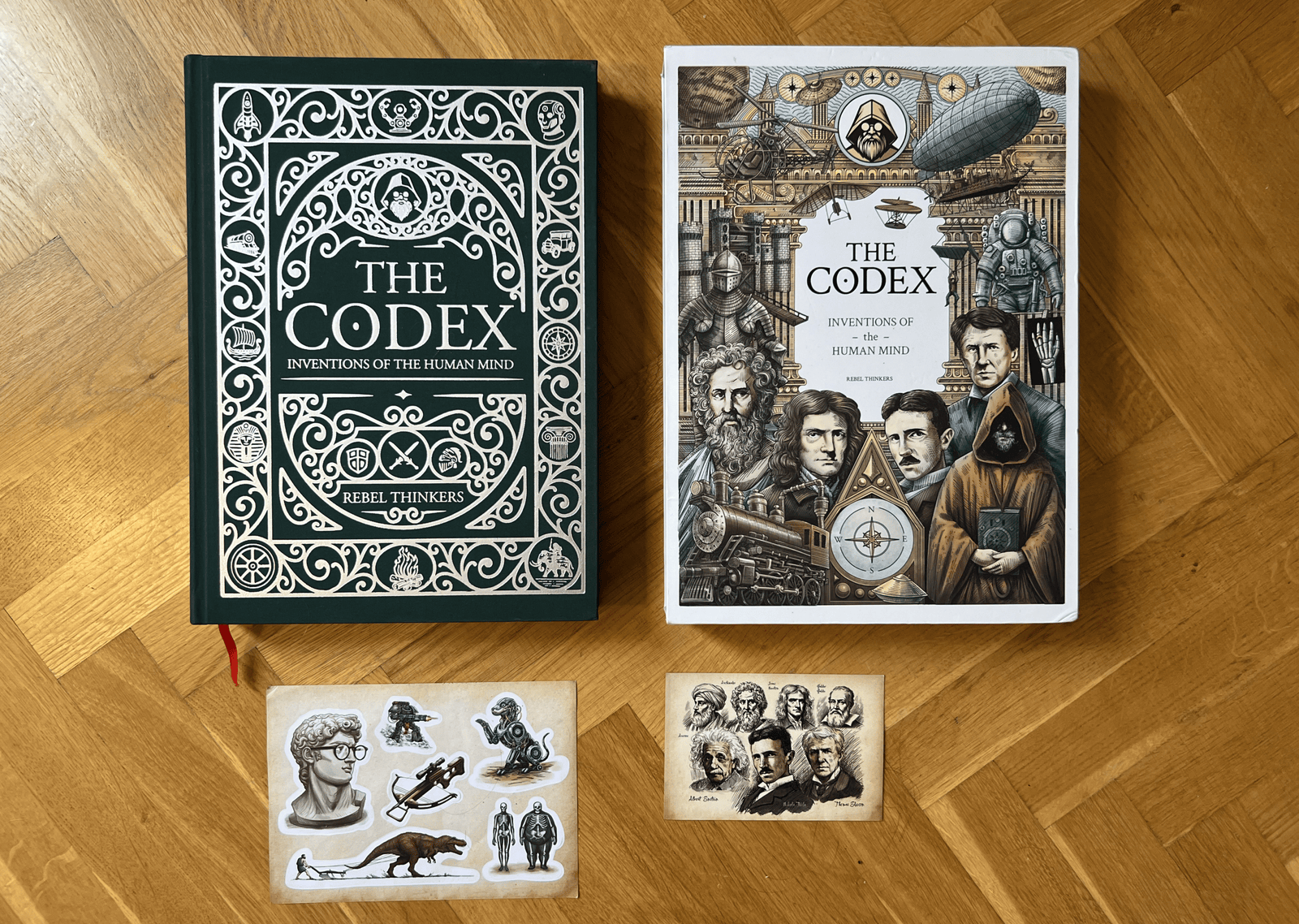
The Codex: Inventions of the Human Mind arrived in a proper gift box, and I'll admit I got a small thrill just lifting the lid — no tape or bubble wrap to fight through, since the box itself was the packaging. Inside was a foil-stamped hardcover, sitting snug in its own case, and for a second I just held it without opening it.
The gold foil on the cover caught my eye first — I ran my thumb along the edges, half-bracing for disappointment. Nothing. No lifting, no rough spots. Up close, the cover is this deep, almost matte green, with the title stamped in a warm gold that flashes differently every time you tilt it in the light. The corners are sharp, the spine is thick without feeling clunky, and next to everything else on my shelf, it just... stands out. The kind of cover that makes people reach for it before they even know what it is.
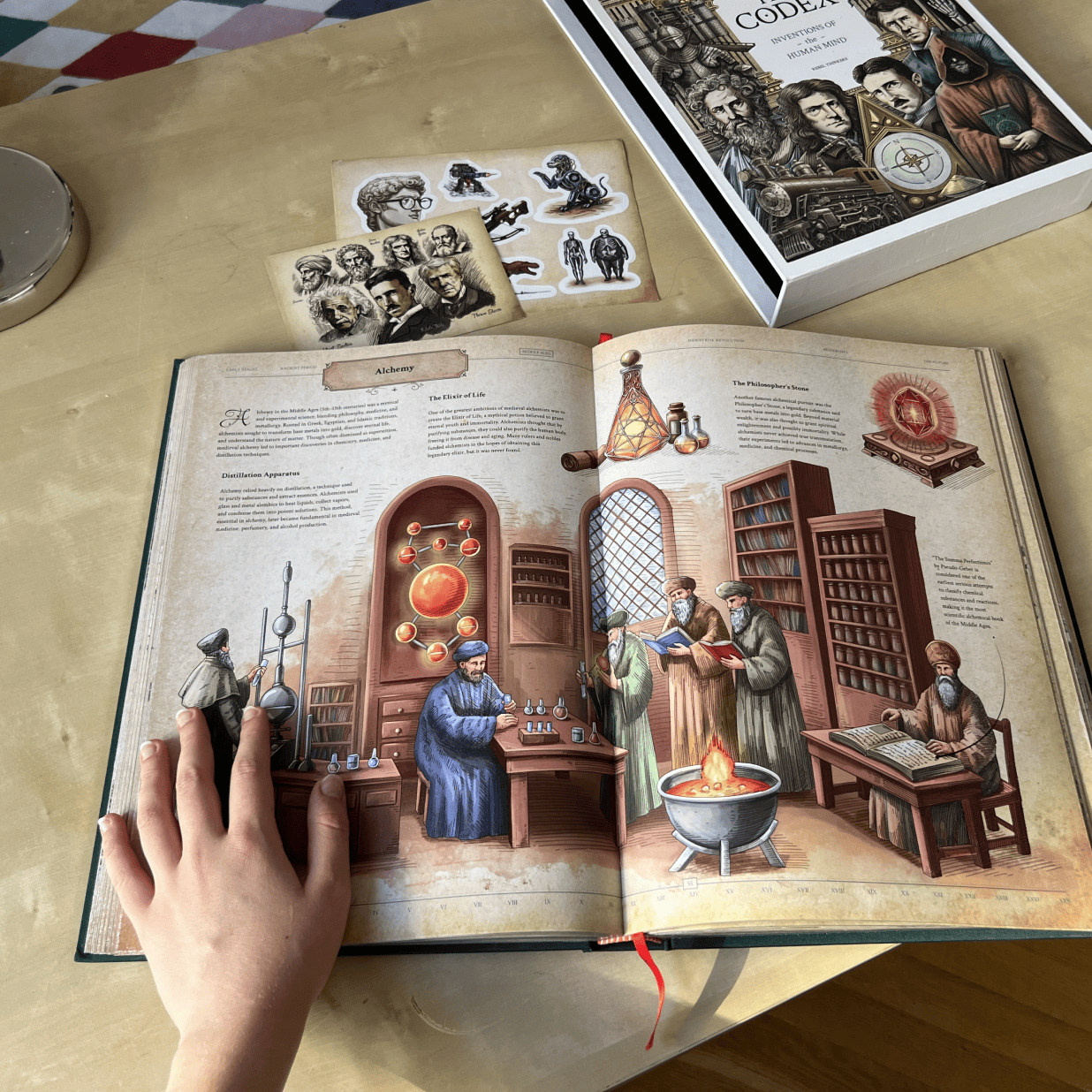


The first thing that got me wasn't even the book — it was the little welcome letter tucked beside it, and a sheet of stickers made from the illustrations inside. Such a small thing, but it caught me off guard. It felt like someone cared whether this moment felt special, not just whether the box arrived intact.
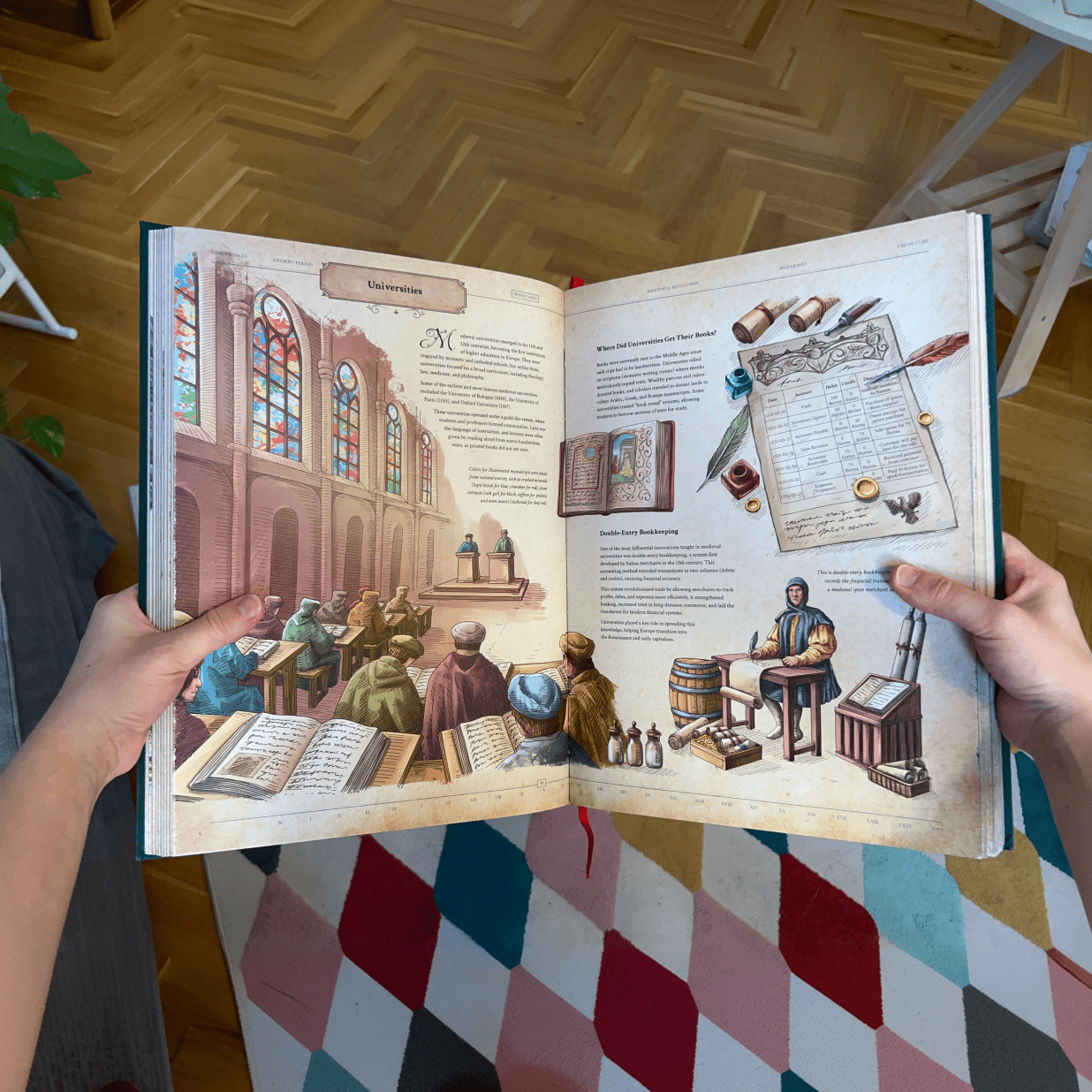
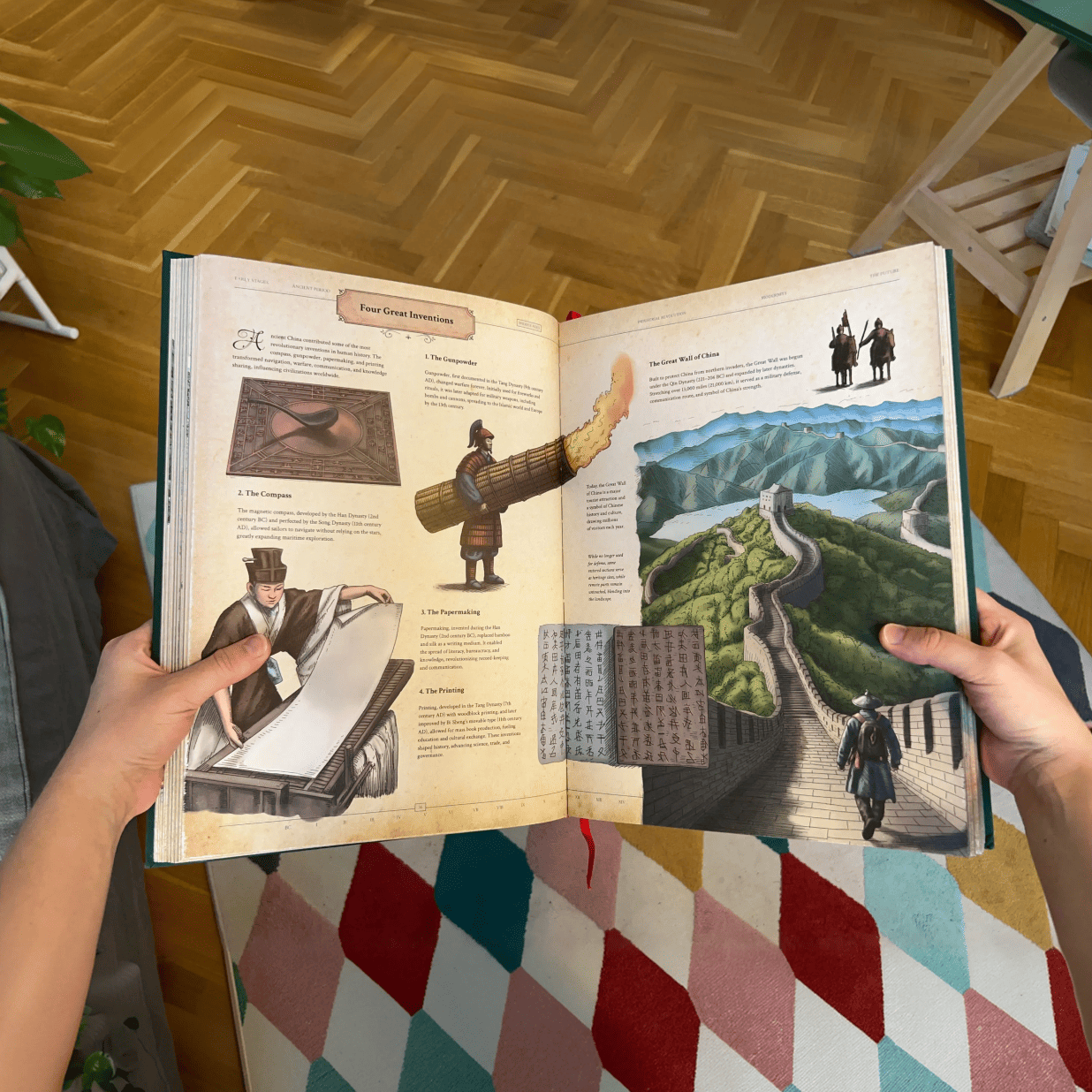
Opening the book itself, I sat there for a second just looking at the layout — each spread built around one invention, one story, text wrapping around the art instead of boxed off to one side. Nothing about it feels like a reference book. And the way it's organized into six eras, from the earliest tools to what might come next, makes the whole thing feel less like a book you consult and more like one you actually follow.

The paper surprised me too — thick, archival, no bleed-through even on the darkest pages. And the size hit me last: bigger than I expected, about 14 by 10 inches (25 × 35 cm). I actually put it on a scale out of curiosity — 3.46 kg (7.62 lbs). So if you're hoping to toss this in a carry-on for a long flight, I have to disappoint you: this one stays on the coffee table.
The Art
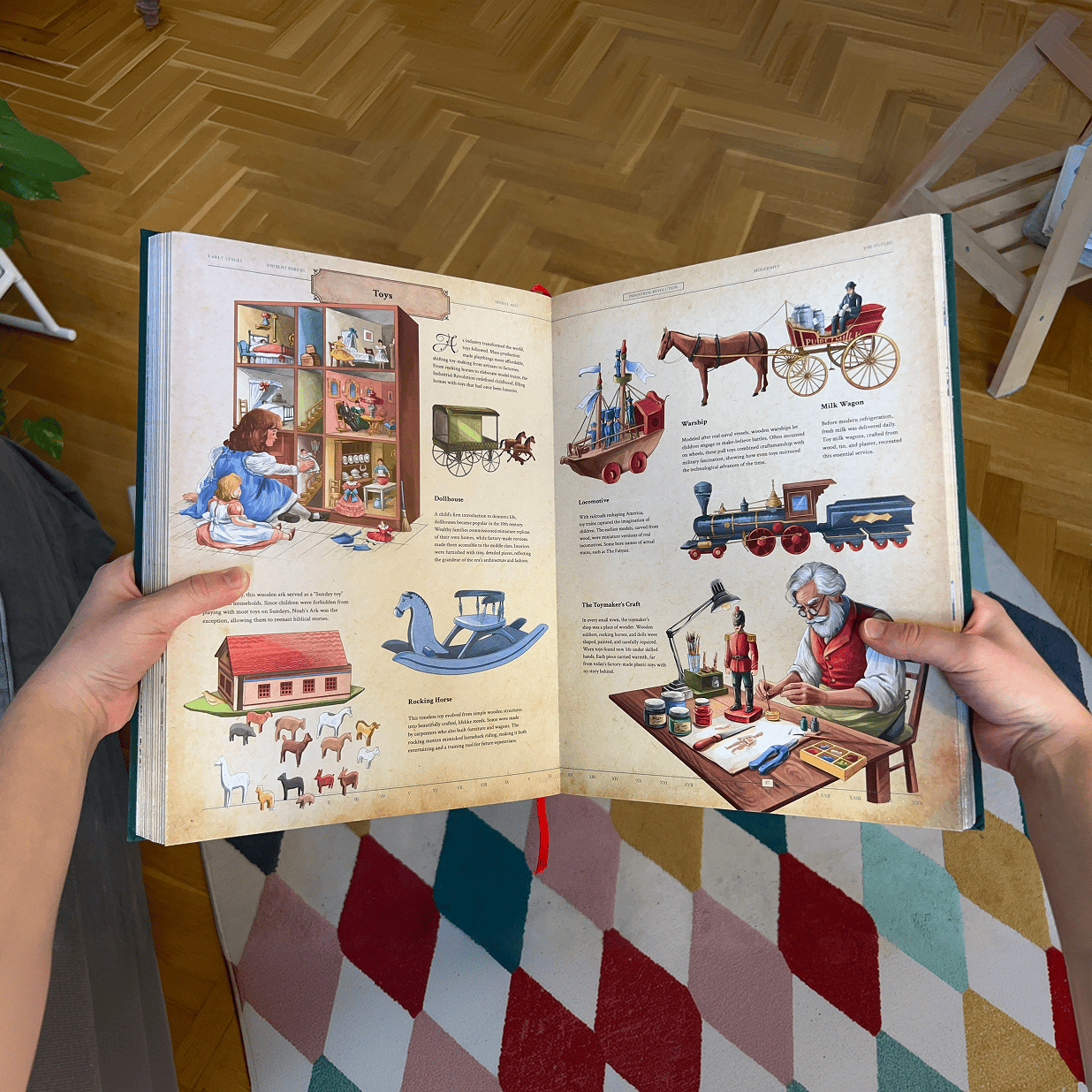
This is the part where I stopped treating it like a review and just... enjoyed the book. Every illustration is hand-drawn, in a style that leans into old manuscript linework instead of clean, modern vector art, and there's something quietly moving about that. Flip through enough pages and you start noticing the small human inconsistencies that only show up in genuine hand-drawn work — the kind that makes you realize a real person sat there and made this, line by line.
I later found out every one of the 900+ illustrations was made by a team of 12 Ukrainian artists, some working through actual power cuts and air raid sirens. Reading that changed something in how I looked at the art. It stopped being decoration. It became the whole reason the book exists, and I felt it every time I turned another page.

- 328+ pages, 900+ hand-drawn illustrations, 150+ inventions
- Foil-stamped hardcover with silver-edged pages
- Thick, 160gsm archival paper — lies flat on its own, no bleed-through
- Bigger than a normal book (14 × 10 in) — built for the detail in the art
- Comes in its own case, inside a gift box ready to hand over as-is
The Content: What's Actually Inside
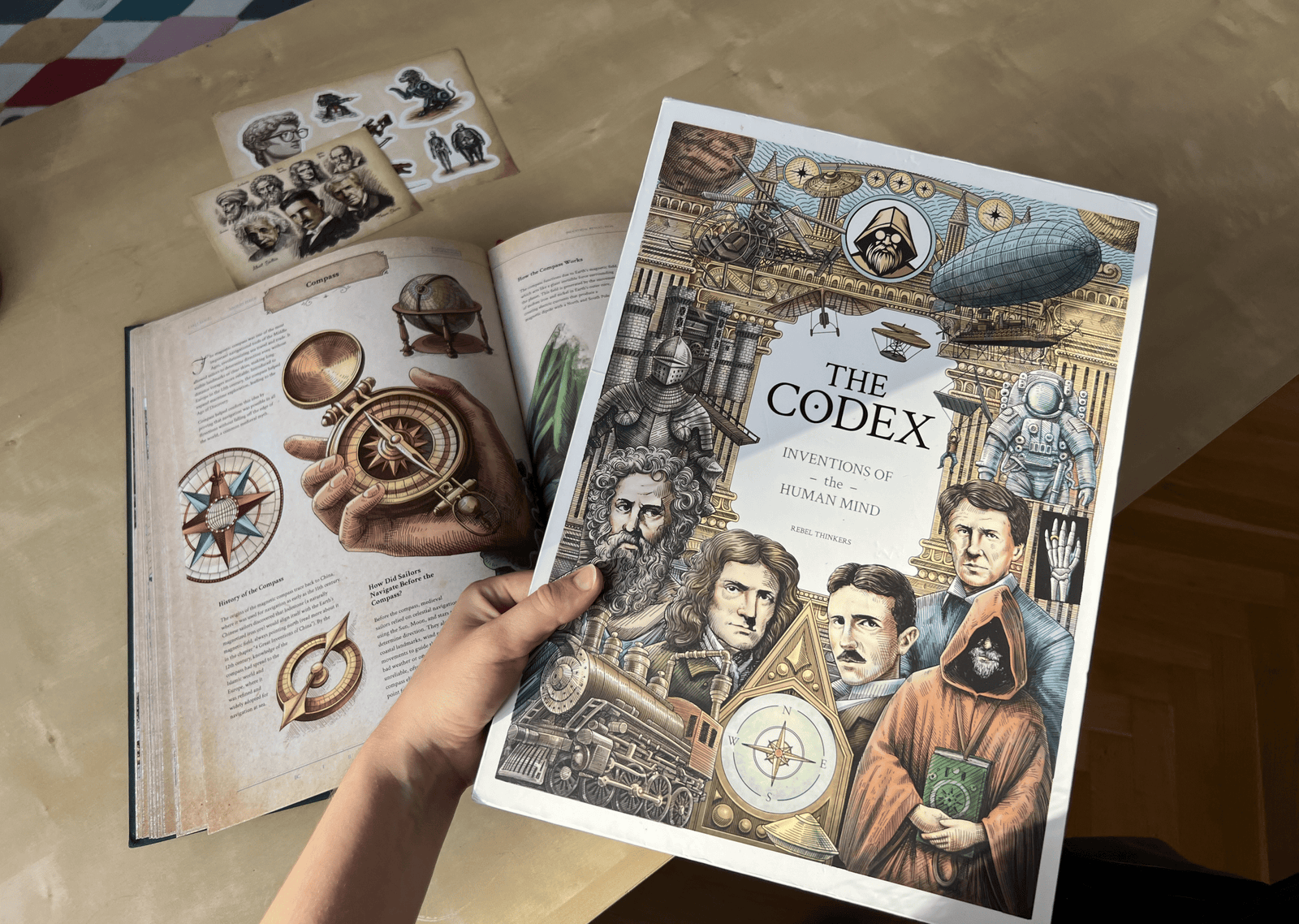
Good production doesn't matter if the content is thin, and that's usually where illustrated "encyclopedias" lose me completely. The Codex didn't. The page on the medieval crossbow, and how the Church tried to ban it outright in 1139 for being too dangerous a weapon, pulled me in and kept me on the couch for another twenty minutes I hadn't planned on giving it. From there I drifted to Archimedes' war machines, then Leonardo's notebooks, then Tesla — no order, no plan, just wandering the way you'd wander a museum you didn't want to leave.
The book is split into six eras, from the earliest tools all the way to what might come next, and that structure means you can open it anywhere and land on something worth your time. Which sounds simple, but it's rare, and it's the reason I keep picking this book back up.
Is It Actually Worth It?
Every one of the 900+ drawings in this book was made by hand, by a team of 12 Ukrainian artists working in Kyiv, Lviv, and smaller towns — some of it during power cuts and air raid sirens. One artist finished a page by candlelight during a six-hour blackout in December 2024. I read that and just sat with it for a minute.
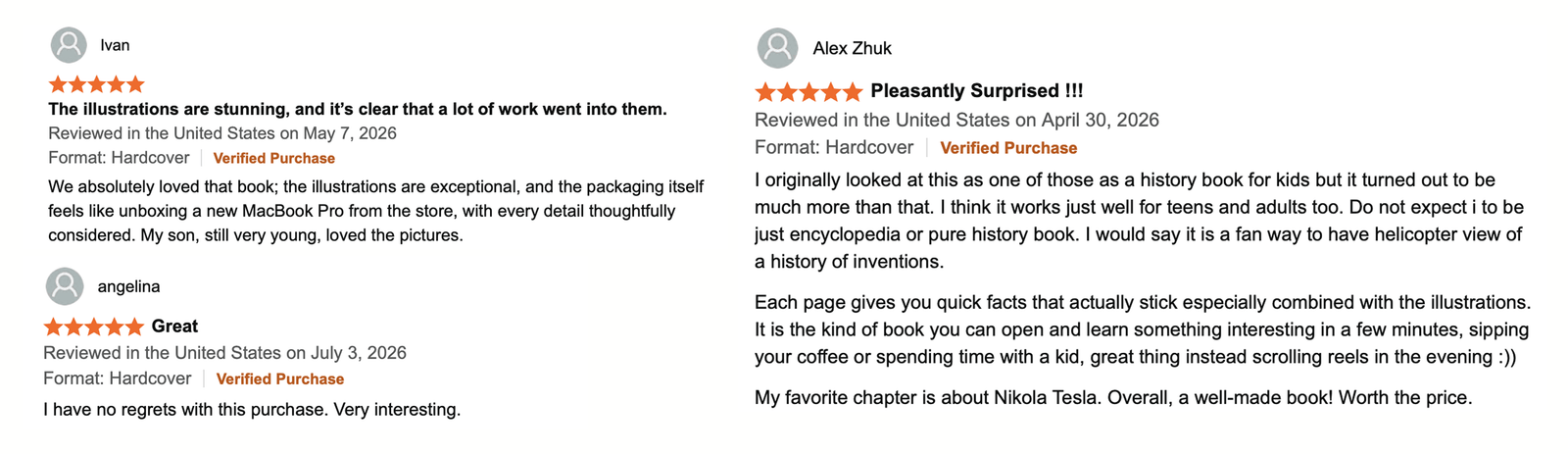
The project started on Kickstarter in November 2024 with a small $5,000 goal and raised $508,241 from 5,327 backers in 44 days — over a hundred times its ask, on the strength of the art alone.
To be clear, the price isn't justified by that story alone — I'd already checked the paper, the binding, and the art first. But knowing it made the price feel like something I was genuinely glad to pay. Worth every cent — I've shown it to a few friends already, and half of them asked where to get their own copy.

The Verdict
Going section by section like this is how I decide whether something actually earns a spot on my shelf, and this one just... kept clearing the bar. Build, paper, art, content — checked, checked, checked, checked. But honestly, it did more than pass a checklist. It's become another reason to put my phone down and sit with my family instead. It's the book friends grab off the table the second they walk in, flipping through it without even asking. And somewhere along the way, it turned into one of those things I'd genuinely want to hand down someday, not just keep to myself.
So if you're into history, or you've got that one niche hobby your friends tease you about — yeah, this is your match.
I didn't expect much, to be honest. Then I opened this HUGE book... I ended up sitting down and losing track of time.
I was impressed with "The Codex." It has far exceeded my expectations


Every one of the 900+ drawings was made by hand, by one of 12 Ukrainian artists. AI was only used early on for rough sketches — never for the final art.

Thick archival paper, silver-edged pages, and a binding that stays flat on its own — the kind of small details that separate a real keeper from a book that just looks good in photos.

It shows up foil-stamped, in its own case, inside a gift box you don't need to wrap — no tape, no assembly, nothing to fight with.

The Codex: Inventions of the Human Mind
350+ pages. 900+ hand-drawn illustrations. 12 Ukrainian artists. The complete illustrated history of the inventions that built the modern world — drawn era by era in a Da Vinci-inspired style.
- Created by 12 Ukrainian Artists
- Da Vinci-inspired illustrated encyclopedia — 350+ pages
- 160gsm archival paper, foil-stamped hardcover, silver-edged pages
- Arrives in premium slipcase
Frequently asked questions
Is it too big for a normal bookshelf?
At 14 × 10 inches (25 × 35 cm), it's really meant to lie flat on a coffee table or a display shelf, not stand spine-out with your paperbacks. Worth measuring your space before you order.
How long does shipping take?
Standard orders normally dispatch within 1–3 business days; peak processing may take up to 7 business days. Standard transit to Zone 1 destinations is estimated at 2–12 business days after dispatch. Other destinations may take longer. Every order ships tracked. Free standard shipping applies to eligible destinations; additional rates are shown at checkout. See our shipping policy for details and exclusions. Preorders follow the schedule stated for that edition.
What if it shows up and I don't love it?
Consultez la politique de retour avant de commander. Elle explique la rétractation, les articles endommagés et les démarches de retour.
Is this a limited edition? Should I order now?
The Codex has sold out twice since its Kickstarter. The current print run is available now. Previous runs had no confirmed reprint timeline between sellouts — there were gaps of several months. If you are considering it, delivery timing varies by destination; see our shipping policy for processing times and delivery estimates. We cannot confirm when the next print run will happen.